
CDP
1.
Mastery Oriented learners typically attribute success to __________ and failure to __________.
2.
Which of the following statement represents ‘Proximodistal’ principle of development ?
3.
According to Vygotsky children speak to themselves :
4.
Challenges in social communication are evident in :
5.
According to Vygotsky’s theory of learning and development, which of the following is an example of scaffolding ?
6.
Dysgraphia is characterised by :
7.
In order to help students to become good problem solvers, a teacher should emphasize on the practice of :
8.
Assertion (A) : Teachers should use multisensory materials to cater to needs of students in an inclusive classroom. Reason (R) : Inclusive classrooms should adopt standardization of curricular materials as well as assessment strategies. Choose the correct option :
9.
In the constructivist view :
10.
Assertion (A) : Effective teachers familiarize themselves with daily lives and socio-cultural backgrounds of learners. Reason (R) : Learning takes place in a social context. Choose the correct option.
11.
Meaningful learning is primarily NOT about :
12.
Assertion (A) : Teacher should encourage boys of her class to participate in sports while assigning art decoration to girls. Reason (R) : Children acquire gender roles primarily because of the underlying biological differences. Choose the correct option.
13.
Kinesthetic learners prefer to learn through __________.
14.
According to Howard Gardner while a scientist would exhibit high __________ Intelligence, a sculptor would have high __________ Intelligence.
15.
Inclusion needs to be promoted through : (i) Flexible curriculum (ii) Cooperative learning (iii) Segregation and labelling (iv) Accessibility of building
16.
Children learn better if they experience :
17.
Assertion (A) : Children below the age of 5 - 6 years should not be pressurized to write ‘properly’ and ‘within the lines’. Reason (R) : Children gain a control of finer motor skills from 5 - 6 years onwards. Choose the correct option.
18.
Children often come up with their own explanations of events around them. On being probed as to why does it rain Sia says - “God was tired of carrying the buckets of water on his shouldersâ€. Such explanations :
19.
Piaget described cognitive development as occurring in :
20.
During play time at school, Rishab, a 7-year-old boy picked a doll to play with. Some of his peers made fun of him for his choice of toy. As a teacher who wants his students to grow up with gender role flexibility, which of the following would be the best response to the situation by the teacher ?
21.
In developmental terms, a time frame where an individual upholds an amplified sensitivity to particular incentives for developing particular skills to function in an efficient manner is referred to as __________ of development.
22.
In order to cater to needs of students struggling with Attention Deficit Hyperactivity Disorder teachers should avoid :
23.
Lawrence Kohlberg argued that :
24.
At which level of Kohlberg’s moral development does individual’s ethical behavior mainly depends on the mindset that “what do people think of me�
25.
According to Jean Piaget a child who is unable to understand the logic behind simple mathematical reversals such as 4+5=9 so 9−5=4, it is because of :
26.
Assertion (A) : Teachers should distance themselves from students and place primary responsibility for learning on them only. Reason (R) : Learning takes place affectively in an authoritative rather than a democratic environment. Choose the correct option.
27.
Assertion (A) : Scaffolding provided by the teachers hinders the learning process of children. Reason (R) : Lev Vygotsky proposed that children learn independently by acting upon and manipulating the environment. Choose the correct option :
28.
Which of the following correctly describes extrinsic motivation ?
29.
Two important cognitive development milestones of sensorimotor stage of Piaget’s theory of cognitive development are :
30.
Children -
Mathematics
31.
What is the result when 7 kg 7 g is subtracted from 9 kg ?
32.
In class III, 150 children were asked to name their one favourite fruit and results for 5 favourite fruits were written in the form of the following table :
Choose the correct option :
| Name of the Fruit | Number of Children |
| Apple | 28 |
| Guava | 26 |
| Mangoes | 44 |
| Banana | 14 |
| Grapes | 28 |
Choose the correct option :
33.
Which of the following is least appropriate about Formative Assessment in mathematics classrooms ?
34.
A person withdrew Rs 4,560 from his bank account on 4th of a month and deposited Rs 2,567 on 20th of the same month. If at the end of the month, balance is Rs 3,125, then money (in Rs) at the start of the month in his account was :
35.
A primary class mathematics teacher gave his students the following problem to solve : “How many classes of 28 pupils would be needed for a school of 616 pupils ?” One of the student solved the problem in the following way :
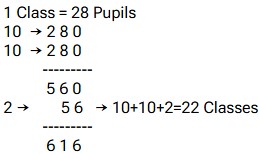
Which of the following is most appropriate for the algorithm used by the student ?
Which of the following is most appropriate for the algorithm used by the student ?
36.
A triangle having all sides of different lengths is called :
37.
The sum of the prime numbers between 31 and 60 is :
38.
The product of the predecessor of 201 and the successor of 4781 is :
39.
What is the most appropriate cognitive skill that help students to recognize and group shapes according to their attributes and properties ?
40.
Students feel difficulty in solving division problems because :
41.
Most II graders are able to add two quantities like four candies and three candies, but when asked to do 4+5 on a worksheet a large number of the same set of learners is unable to do so. What is the most appropriate explanation of this observation according to National Curriculum Framework 2005 ?
42.
A 3rd standard student, when asked to write one hundred and five in numeral form, s/he writes it as ‘1005’. This indicates that :
43.
Which of the following statements is NOT true with respect to the concept of Fractions ?
44.
Radha walks 3 km 725 m per day on Monday, Wednesday and Friday, whereas she walks 2 km 9 m per day on Tuesday and Thursday. Total distance covered by her from Monday to Friday is :
45.
Jasmine said, “A rectangle has two pairs of opposite sides parallel; a square also has two pairs of opposite sides parallel and so does a parallelogram. So, both rectangle and square are also parallelograms.†Jasmine is at _________ stage of Van Hieles theory of geometric thinking.
46.
The sum of the greatest and smallest six digit numbers that can be formed from the digits 5, 9, 0, 2, 8 and 6 (without repetition) is :
47.
The missing numbers in the pattern 12, 14, 17, 13, 8, 14, 21, _, _ are respectively :
48.
The smallest four-digit number which is a multiple of 6, 7 and 4 is :
49.
Which of the following has a definite length ?
50.
Which of the following is most appropriate for including open ended questions in mathematics class ?
51.
Which of the following statements are true with respect to ‘Data handling’ ?
52.
How many planks of size 2 m ×35 cm × 8 cm can be made from a wooden block 8 m long, 70 cm wide and 40 cm thick ?
53.
A child solved a problem :
\({1 \over 2} + {1 \over 3} = {2 \over 5}\)
What is the most appropriate inference drawn from the solution ?
\({1 \over 2} + {1 \over 3} = {2 \over 5}\)
What is the most appropriate inference drawn from the solution ?
54.
According to National Education Policy 2020 Mathematics and Computational Thinking is to be given increased importance as :
55.
According to National Curriculum Framework 2005 mathematics teachers need to shift towards : (a) Promoting memorization and rigorous algorithms (b) Mathematical reasoning and logic (c) Becoming sole authority for right answers Choose the correct option :
56.
Which one of the following is the most effective way to introduce the concept of area to fourth graders ?
57.
The value of \({4 \over 7} + {5 \over 14} - {7 \over 8}\) is :
58.
Which of the following letters has two lines of symmetry ?
59.
Which of the following is NOT related to Indian mathematics ?
60.
The difference of the place values of 5 and 7 in the number 352876 is :
EVS
61.
Read the Assertion and Reason properly. Assertion : An elephant herd has only female and baby elephants. Reason : Male elephants leave their herd after 14 - 15 years and move around alone. Choose the correct answer from the following :
62.
Chapter 4 “Mangoes Round the Year†of NCERT Environmental Studies textbook has a story on making mango papad so that children not only understand the process and technique but also appreciate the skills of cooking and preservation. As per NCF 2005, which general objective of teaching EVS is being achieved through this lesson ?
63.
Mohan is a class V teacher of Environmental Studies. He writes the following activity on the blackboard in his class. “Find out about the availability of water at the time of your parents and grandparents and compare it with the current situation.†For the above activity, which of the following strategies would be most appropriate ?
64.
Archana is a teacher of Environmental Studies teaching class IV. She forms two groups of children in her class and conducts a debate activity on the topic “Should the school have uniforms or notâ€. Why did Archana organize a debate in her class ? Which of the following may not be the most appropriate reason ? (A) Debate gives children an opportunity to think about and understand different aspects of a topic. (B) Children are encouraged to express their views in the classroom. (C) Children get an opportunity to share their experiences in the classroom. (D) Children assess the knowledge of their peers through debate.
65.
Child describes different skilled work related to farming and their inheritance (from elders) in daily life. The above statement is :
66.
The state/union territory having coast on the Bay of Bengal is :
67.
Lesson 13 in NCERT’s Class V Environmental Studies textbook describes the amazing journey of “Gaurav Janiâ€. This lesson is a part of which of the following themes ?
68.
In a constructivist EVS classroom, which of the following is NOT seen to be happening ?
69.
Siddhi is a teacher of class 4. She takes all the children of her class to the playground to play Kabbadi, while teaching them lesson 10 “Hu tu tu, hu tu tu†of the NCERT Environmental Studies textbook. Before playing the game, she also explains the rules of this game to all the children. Why does the teacher tell the children the rules before playing this game ? Which of the following may be the most appropriate reason ? (A) She wants to draw the attention of the children that in life like in sports, we make rules. (B) So that all the work is done properly. (C) We are all bound by the rules in the same way in the society by which we settle differences and conflicts among ourselves. (D) By making rules, the attention of all children is much more on the rules than on the game.
70.
Read the following statements and choose the correct option. Assertion (A) : Biomass and Fossil Fuels are the two main conventional sources of energy. Reason (R) : Conventional sources are those which are renewable in nature.
71.
Consider the following statements A and B. Statement A : In 1969, Neil Armstrong was the first man to walk on the moon. Statement B : In 2007, Kalpana Chawla set a new record for the longest space flight by a woman. Select the correct code from the following :
72.
It has been observed that some mistakes are made while observing the learning and progress of children. These mistakes may be the result of our biases. Which of the following information should not be recorded as a bias ?
73.
Read the Assertion (A) and Reason (R) carefully - Assertion (A) : The goats from which the soft pashmina wool is collected are found on very high altitudes of 5000 meters in extreme cold. Reason (R) : A coat of warm hair grows on goats body which protects it from extreme cold. Choose the correct option from the following :
74.
Read the statements I and II. Statement I : Due to anaemia, children do not grow well, and their energy levels are low. Statement II : Anaemia affects both, children’s physical as well as mental health. Choose the correct answer from the following :
75.
Select the correct match from the following :
76.
Cows have Short front teeth and Large and flat side teeth for which one of the following ?
77.
What is the reason why tales and stories have been given an important place in the textbooks of Environmental Studies ? Which of the following may be the most appropriate reason ? (A) At the primary level, the teachers of Environmental Studies narrate tales and stories with interest, that is why they have been given an important place. (B) The use of stories has often been considered important in developing children’s sensitivity to environmental issues. (C) Because children easily relate themselves to the characters of the story, that is why they have been given an important place in the textbooks. (D) Tales and stories are liked by the society, that is why they have been given an important place in the textbooks of the environment.
78.
In the following question, Assertion and Reason are followed. Read the statements carefully and choose the correct option from the following : Assertion : In the lessons of NCERT’s Environmental Studies textbook, real incidents of common life, everyday problems and some burning problems related to today have been kept. Reason : Children can debate openly on all these problems, be aware of the problems, be sensitive to them and make correct understanding.
79.
How much time ‘boiled milk’ takes for digestion in the stomach ? Choose the correct answer from the following :
80.
A person would not drown in the dead sea or a salty lake even if the person does not know how to swim. This is due to :
81.
Which one of the following is a group consisting of elements only ?
82.
A teacher of Environmental Studies, while conducting an activity with some children, observes some important incidents and also makes a descriptive note of the same. Which of the following may be the tool of assessment ?
83.
Two Indian birds make nests which hang from the branches of trees or bushes. These two birds are :
84.
Read the statements A and B carefully - Statement A : During the cold season lizards go into a long and deep sleep. Statement B : Some animals go into a long, deep sleep in certain seasons. Choose the correct answer from the following :
85.
A teacher in his environmental studies class, divides the children into groups and asks them to collect some objects present in the school. After that he sits with the children and asks them to distribute those objects into different groups. Children divide objects into different groups on the basis of their properties. What could be the most appropriate purpose for the teacher to conduct this activity ?
86.
Rakesh is a teacher of Environmental Studies of class V. He asks the children in his class to do an activity. In which, all children observe which “object floats in water and which sinks in water†? After the activity some children ask the teacher why some objects sink in water and some objects float in water. What is the most appropriate thing a teacher should do in the following situation ? (A) The teacher should tell the children that this is happening because of the density. (B) Give each child the freedom to observe, record their observations, and interpret those observations. (C) Provide opportunity to each child to hypothesize, test and make activity based generalizations. (D) Teacher should say that the main reason for this you will understand in your higher classes.
87.
It is 10 A.M. now in India today, it is around noon of today in _________.
88.
In a child centered EVS classroom, which of the following activities would be LEAST likely to occur ?
89.
A person boarded an express train on 30 January 2023 at New Delhi for Bangalore. The train departed from New Delhi at 17 : 00 hours and reached Bangalore at 17 : 00 hours on 31st January 2023. If the distance between New Delhi and Bangalore by train route is nearly 1776 km. The average speed of the train during this Journey was :
90.
In the following question, Assertion and Reason are followed. Read the statements carefully and choose the correct option from the following : Assertion : The curriculum of Environmental Studies is theme-based and each theme is interreleted. Reason : The main reason for keeping the syllabus of Environmental Studies theme-based is that it creates a deep understanding of each theme and each theme begins with questions.
Bengali - Language I
91.
নিম্নে প্রদত্ত গদ্যাংশটি পড়ুন এবং সংশ্লিষ্ট প্রশ্নগুলির সঠিক উত্তর নির্বাচন করুন।
শেষ শীতের সকাল । দীপু বাগানে গিয়ে দেখল, সেখানে গাছগাছালির মধ্যে সবুজের মেলায় কত বিচিত্র বর্ণের ফুল। আর ফুলের
বনে রঙ-বেরঙের কত প্রজাপতির আনাগোনা। কী সুন্দর এই প্রজাপতি! নানা রকম নক্সা-আঁকা চিত্র-বিচিত্র পাখা নেড়ে নেড়ে ফুলের
বনে ফুরফুর করে উড়ে বেড়াচ্ছে। হঠাৎ কোনটা ফুলের বুকে আলগোছে বসে পড়ে। ফুলটা চমকে দুলে ওঠে। প্রজাপতি মধু লুটে ডানা
মেলে উড়ে যায়। আবার, আর এক ফুলে গিয়ে বসে।
দীপু লক্ষ্য করল, প্রজাপতি যখন কোথাও বসে, তখন ডানাগুলো মুড়ে পিঠের ওপর খাড়াভাবে তুলে দেয়, নৌকার পালের
মতো করে । এ সময় ডানার নিচের দিকটা দেখা যায় । দীপু অবাক হয়ে দেখল, ডানার নিচের দিকটায় কিন্তু এতো রঙের বাহার নেই। এর
কারণ কী? দীপুর হঠাৎ মনে পড়ল, সে বইয়ে পড়েছে, বসে থাকা প্রজাপতির মুড়ে রাখা ডানার নক্সা ও রং প্রায়ই এমন হয় যে, সে
অনায়াসে গাছের পাতা বা ফুলের সঙ্গে একেবারে মিশে থাকতে পারে। এজন্য উড়তে উড়তে হঠাৎ কোথাও বসে পড়লে, তার শত্রু-
পাখিরা তাকে আর দেখতে পায় না। তাইতো সে বেঁচে থাকার সুযোগ পায় ।
দীপু খানিকক্ষণ ছুটোছুটি করে একটা প্রজাপতি ধরে ফেললো। প্রজাপতির পাখনা থেকে গুঁড়ো গুঁড়ো রং উঠে গিয়ে তার
আঙুলে লেগে গেল। সে বুঝল, এগুলো প্রজাপতির ডানার আঁশ। এই আঁশগুলো রঙিন, আর এগুলোর জন্যই প্রজাপতির ডানার এতো
বাহার।
প্রজাপতিটা হাতে নিয়ে দীপু তার দেহের বিভিন্ন অংশ বেশ ভালো করে লক্ষ্য করতে লাগল । এরই নাম পর্যবেক্ষণ। সে দেখল,
একটা ছোট গোল মাথা, একটা মাঝারি আকারের বুক, আর একটা সরু লম্বা পেট— এই তিনটি অংশ দিয়ে প্রজাপতির দেহটা তৈরি।
মাথা থেকে দুটো লম্বা শুঙ্গ বা শুঁয়ো (অ্যানটেনা) বেরিয়েছে। শুঙ্গের ডগা একটু মোটা। প্রজাপতি যে ফুল থেকে মধু খায়, সেই ফুলে
এই শুঙ্গ ঠেকিয়ে, কি ফুল, কেমন তার মধু, এইসব সে বুঝতে পারে। শুঙ্গের ঠিক গোড়াতেই দুটো বেশ বড়ো বড়ো চোখ (পুঞ্জাক্ষি
অর্থাৎ অনেকগুলো ছোট ছোট চোখের সমষ্টি)।
প্রজাপতির মুখটা বড়ো অদ্ভুত। তার চোয়ালগুলো জুড়ে গিয়ে একটা বেশ বড়ো শোষক-নল তৈরি হয়েছে। এই নলটা কিন্তু
গুটানো থাকে। খাবার সময়, সে নলটা সোজা করে ফুলের মধ্যে ঢুকিয়ে দেয়, এবং বেশ আরাম করে ফুলের মধু চুষে খায়। এ জন্যই
প্রজাপতি ফুলের মধু ছাড়া আর কিছুই খেতে পারে না। প্রজাপতি ফুলে ফুলে উড়ে উড়ে মধু খায়, আর সেই সুযোগে ফুলের পরাগ-
সংযোগে সহায়তা করে। প্রজাপতি আমাদের অনেক উপকার করে। তবে শুঁয়াপোকা অবস্থায়, এরা ফসলের প্রভূত ক্ষতিসাধন করে।
সেজন্য এরা আমাদের অনিষ্টকারী পতঙ্গ বলে গণ্য হয়।
শেষ শীতের সকাল । দীপু বাগানে গিয়ে দেখল, সেখানে গাছগাছালির মধ্যে সবুজের মেলায় কত বিচিত্র বর্ণের ফুল। আর ফুলের
বনে রঙ-বেরঙের কত প্রজাপতির আনাগোনা। কী সুন্দর এই প্রজাপতি! নানা রকম নক্সা-আঁকা চিত্র-বিচিত্র পাখা নেড়ে নেড়ে ফুলের
বনে ফুরফুর করে উড়ে বেড়াচ্ছে। হঠাৎ কোনটা ফুলের বুকে আলগোছে বসে পড়ে। ফুলটা চমকে দুলে ওঠে। প্রজাপতি মধু লুটে ডানা
মেলে উড়ে যায়। আবার, আর এক ফুলে গিয়ে বসে।
দীপু লক্ষ্য করল, প্রজাপতি যখন কোথাও বসে, তখন ডানাগুলো মুড়ে পিঠের ওপর খাড়াভাবে তুলে দেয়, নৌকার পালের
মতো করে । এ সময় ডানার নিচের দিকটা দেখা যায় । দীপু অবাক হয়ে দেখল, ডানার নিচের দিকটায় কিন্তু এতো রঙের বাহার নেই। এর
কারণ কী? দীপুর হঠাৎ মনে পড়ল, সে বইয়ে পড়েছে, বসে থাকা প্রজাপতির মুড়ে রাখা ডানার নক্সা ও রং প্রায়ই এমন হয় যে, সে
অনায়াসে গাছের পাতা বা ফুলের সঙ্গে একেবারে মিশে থাকতে পারে। এজন্য উড়তে উড়তে হঠাৎ কোথাও বসে পড়লে, তার শত্রু-
পাখিরা তাকে আর দেখতে পায় না। তাইতো সে বেঁচে থাকার সুযোগ পায় ।
দীপু খানিকক্ষণ ছুটোছুটি করে একটা প্রজাপতি ধরে ফেললো। প্রজাপতির পাখনা থেকে গুঁড়ো গুঁড়ো রং উঠে গিয়ে তার
আঙুলে লেগে গেল। সে বুঝল, এগুলো প্রজাপতির ডানার আঁশ। এই আঁশগুলো রঙিন, আর এগুলোর জন্যই প্রজাপতির ডানার এতো
বাহার।
প্রজাপতিটা হাতে নিয়ে দীপু তার দেহের বিভিন্ন অংশ বেশ ভালো করে লক্ষ্য করতে লাগল । এরই নাম পর্যবেক্ষণ। সে দেখল,
একটা ছোট গোল মাথা, একটা মাঝারি আকারের বুক, আর একটা সরু লম্বা পেট— এই তিনটি অংশ দিয়ে প্রজাপতির দেহটা তৈরি।
মাথা থেকে দুটো লম্বা শুঙ্গ বা শুঁয়ো (অ্যানটেনা) বেরিয়েছে। শুঙ্গের ডগা একটু মোটা। প্রজাপতি যে ফুল থেকে মধু খায়, সেই ফুলে
এই শুঙ্গ ঠেকিয়ে, কি ফুল, কেমন তার মধু, এইসব সে বুঝতে পারে। শুঙ্গের ঠিক গোড়াতেই দুটো বেশ বড়ো বড়ো চোখ (পুঞ্জাক্ষি
অর্থাৎ অনেকগুলো ছোট ছোট চোখের সমষ্টি)।
প্রজাপতির মুখটা বড়ো অদ্ভুত। তার চোয়ালগুলো জুড়ে গিয়ে একটা বেশ বড়ো শোষক-নল তৈরি হয়েছে। এই নলটা কিন্তু
গুটানো থাকে। খাবার সময়, সে নলটা সোজা করে ফুলের মধ্যে ঢুকিয়ে দেয়, এবং বেশ আরাম করে ফুলের মধু চুষে খায়। এ জন্যই
প্রজাপতি ফুলের মধু ছাড়া আর কিছুই খেতে পারে না। প্রজাপতি ফুলে ফুলে উড়ে উড়ে মধু খায়, আর সেই সুযোগে ফুলের পরাগ-
সংযোগে সহায়তা করে। প্রজাপতি আমাদের অনেক উপকার করে। তবে শুঁয়াপোকা অবস্থায়, এরা ফসলের প্রভূত ক্ষতিসাধন করে।
সেজন্য এরা আমাদের অনিষ্টকারী পতঙ্গ বলে গণ্য হয়।
প্রজাপতির রঙিন বাহারি পাখনার রং তার কী কাজে লাগে ?
92.
নিম্নে প্রদত্ত গদ্যাংশটি পড়ুন এবং সংশ্লিষ্ট প্রশ্নগুলির সঠিক উত্তর নির্বাচন করুন।
শেষ শীতের সকাল । দীপু বাগানে গিয়ে দেখল, সেখানে গাছগাছালির মধ্যে সবুজের মেলায় কত বিচিত্র বর্ণের ফুল। আর ফুলের
বনে রঙ-বেরঙের কত প্রজাপতির আনাগোনা। কী সুন্দর এই প্রজাপতি! নানা রকম নক্সা-আঁকা চিত্র-বিচিত্র পাখা নেড়ে নেড়ে ফুলের
বনে ফুরফুর করে উড়ে বেড়াচ্ছে। হঠাৎ কোনটা ফুলের বুকে আলগোছে বসে পড়ে। ফুলটা চমকে দুলে ওঠে। প্রজাপতি মধু লুটে ডানা
মেলে উড়ে যায়। আবার, আর এক ফুলে গিয়ে বসে।
দীপু লক্ষ্য করল, প্রজাপতি যখন কোথাও বসে, তখন ডানাগুলো মুড়ে পিঠের ওপর খাড়াভাবে তুলে দেয়, নৌকার পালের
মতো করে । এ সময় ডানার নিচের দিকটা দেখা যায় । দীপু অবাক হয়ে দেখল, ডানার নিচের দিকটায় কিন্তু এতো রঙের বাহার নেই। এর
কারণ কী? দীপুর হঠাৎ মনে পড়ল, সে বইয়ে পড়েছে, বসে থাকা প্রজাপতির মুড়ে রাখা ডানার নক্সা ও রং প্রায়ই এমন হয় যে, সে
অনায়াসে গাছের পাতা বা ফুলের সঙ্গে একেবারে মিশে থাকতে পারে। এজন্য উড়তে উড়তে হঠাৎ কোথাও বসে পড়লে, তার শত্রু-
পাখিরা তাকে আর দেখতে পায় না। তাইতো সে বেঁচে থাকার সুযোগ পায় ।
দীপু খানিকক্ষণ ছুটোছুটি করে একটা প্রজাপতি ধরে ফেললো। প্রজাপতির পাখনা থেকে গুঁড়ো গুঁড়ো রং উঠে গিয়ে তার
আঙুলে লেগে গেল। সে বুঝল, এগুলো প্রজাপতির ডানার আঁশ। এই আঁশগুলো রঙিন, আর এগুলোর জন্যই প্রজাপতির ডানার এতো
বাহার।
প্রজাপতিটা হাতে নিয়ে দীপু তার দেহের বিভিন্ন অংশ বেশ ভালো করে লক্ষ্য করতে লাগল । এরই নাম পর্যবেক্ষণ। সে দেখল,
একটা ছোট গোল মাথা, একটা মাঝারি আকারের বুক, আর একটা সরু লম্বা পেট— এই তিনটি অংশ দিয়ে প্রজাপতির দেহটা তৈরি।
মাথা থেকে দুটো লম্বা শুঙ্গ বা শুঁয়ো (অ্যানটেনা) বেরিয়েছে। শুঙ্গের ডগা একটু মোটা। প্রজাপতি যে ফুল থেকে মধু খায়, সেই ফুলে
এই শুঙ্গ ঠেকিয়ে, কি ফুল, কেমন তার মধু, এইসব সে বুঝতে পারে। শুঙ্গের ঠিক গোড়াতেই দুটো বেশ বড়ো বড়ো চোখ (পুঞ্জাক্ষি
অর্থাৎ অনেকগুলো ছোট ছোট চোখের সমষ্টি)।
প্রজাপতির মুখটা বড়ো অদ্ভুত। তার চোয়ালগুলো জুড়ে গিয়ে একটা বেশ বড়ো শোষক-নল তৈরি হয়েছে। এই নলটা কিন্তু
গুটানো থাকে। খাবার সময়, সে নলটা সোজা করে ফুলের মধ্যে ঢুকিয়ে দেয়, এবং বেশ আরাম করে ফুলের মধু চুষে খায়। এ জন্যই
প্রজাপতি ফুলের মধু ছাড়া আর কিছুই খেতে পারে না। প্রজাপতি ফুলে ফুলে উড়ে উড়ে মধু খায়, আর সেই সুযোগে ফুলের পরাগ-
সংযোগে সহায়তা করে। প্রজাপতি আমাদের অনেক উপকার করে। তবে শুঁয়াপোকা অবস্থায়, এরা ফসলের প্রভূত ক্ষতিসাধন করে।
সেজন্য এরা আমাদের অনিষ্টকারী পতঙ্গ বলে গণ্য হয়।
শেষ শীতের সকাল । দীপু বাগানে গিয়ে দেখল, সেখানে গাছগাছালির মধ্যে সবুজের মেলায় কত বিচিত্র বর্ণের ফুল। আর ফুলের
বনে রঙ-বেরঙের কত প্রজাপতির আনাগোনা। কী সুন্দর এই প্রজাপতি! নানা রকম নক্সা-আঁকা চিত্র-বিচিত্র পাখা নেড়ে নেড়ে ফুলের
বনে ফুরফুর করে উড়ে বেড়াচ্ছে। হঠাৎ কোনটা ফুলের বুকে আলগোছে বসে পড়ে। ফুলটা চমকে দুলে ওঠে। প্রজাপতি মধু লুটে ডানা
মেলে উড়ে যায়। আবার, আর এক ফুলে গিয়ে বসে।
দীপু লক্ষ্য করল, প্রজাপতি যখন কোথাও বসে, তখন ডানাগুলো মুড়ে পিঠের ওপর খাড়াভাবে তুলে দেয়, নৌকার পালের
মতো করে । এ সময় ডানার নিচের দিকটা দেখা যায় । দীপু অবাক হয়ে দেখল, ডানার নিচের দিকটায় কিন্তু এতো রঙের বাহার নেই। এর
কারণ কী? দীপুর হঠাৎ মনে পড়ল, সে বইয়ে পড়েছে, বসে থাকা প্রজাপতির মুড়ে রাখা ডানার নক্সা ও রং প্রায়ই এমন হয় যে, সে
অনায়াসে গাছের পাতা বা ফুলের সঙ্গে একেবারে মিশে থাকতে পারে। এজন্য উড়তে উড়তে হঠাৎ কোথাও বসে পড়লে, তার শত্রু-
পাখিরা তাকে আর দেখতে পায় না। তাইতো সে বেঁচে থাকার সুযোগ পায় ।
দীপু খানিকক্ষণ ছুটোছুটি করে একটা প্রজাপতি ধরে ফেললো। প্রজাপতির পাখনা থেকে গুঁড়ো গুঁড়ো রং উঠে গিয়ে তার
আঙুলে লেগে গেল। সে বুঝল, এগুলো প্রজাপতির ডানার আঁশ। এই আঁশগুলো রঙিন, আর এগুলোর জন্যই প্রজাপতির ডানার এতো
বাহার।
প্রজাপতিটা হাতে নিয়ে দীপু তার দেহের বিভিন্ন অংশ বেশ ভালো করে লক্ষ্য করতে লাগল । এরই নাম পর্যবেক্ষণ। সে দেখল,
একটা ছোট গোল মাথা, একটা মাঝারি আকারের বুক, আর একটা সরু লম্বা পেট— এই তিনটি অংশ দিয়ে প্রজাপতির দেহটা তৈরি।
মাথা থেকে দুটো লম্বা শুঙ্গ বা শুঁয়ো (অ্যানটেনা) বেরিয়েছে। শুঙ্গের ডগা একটু মোটা। প্রজাপতি যে ফুল থেকে মধু খায়, সেই ফুলে
এই শুঙ্গ ঠেকিয়ে, কি ফুল, কেমন তার মধু, এইসব সে বুঝতে পারে। শুঙ্গের ঠিক গোড়াতেই দুটো বেশ বড়ো বড়ো চোখ (পুঞ্জাক্ষি
অর্থাৎ অনেকগুলো ছোট ছোট চোখের সমষ্টি)।
প্রজাপতির মুখটা বড়ো অদ্ভুত। তার চোয়ালগুলো জুড়ে গিয়ে একটা বেশ বড়ো শোষক-নল তৈরি হয়েছে। এই নলটা কিন্তু
গুটানো থাকে। খাবার সময়, সে নলটা সোজা করে ফুলের মধ্যে ঢুকিয়ে দেয়, এবং বেশ আরাম করে ফুলের মধু চুষে খায়। এ জন্যই
প্রজাপতি ফুলের মধু ছাড়া আর কিছুই খেতে পারে না। প্রজাপতি ফুলে ফুলে উড়ে উড়ে মধু খায়, আর সেই সুযোগে ফুলের পরাগ-
সংযোগে সহায়তা করে। প্রজাপতি আমাদের অনেক উপকার করে। তবে শুঁয়াপোকা অবস্থায়, এরা ফসলের প্রভূত ক্ষতিসাধন করে।
সেজন্য এরা আমাদের অনিষ্টকারী পতঙ্গ বলে গণ্য হয়।
প্রজাপতির কোন রূপটি উদ্ভিদ জগতের উপকারে আসে?
93.
নিম্নে প্রদত্ত গদ্যাংশটি পড়ুন এবং সংশ্লিষ্ট প্রশ্নগুলির সঠিক উত্তর নির্বাচন করুন।
শেষ শীতের সকাল । দীপু বাগানে গিয়ে দেখল, সেখানে গাছগাছালির মধ্যে সবুজের মেলায় কত বিচিত্র বর্ণের ফুল। আর ফুলের
বনে রঙ-বেরঙের কত প্রজাপতির আনাগোনা। কী সুন্দর এই প্রজাপতি! নানা রকম নক্সা-আঁকা চিত্র-বিচিত্র পাখা নেড়ে নেড়ে ফুলের
বনে ফুরফুর করে উড়ে বেড়াচ্ছে। হঠাৎ কোনটা ফুলের বুকে আলগোছে বসে পড়ে। ফুলটা চমকে দুলে ওঠে। প্রজাপতি মধু লুটে ডানা
মেলে উড়ে যায়। আবার, আর এক ফুলে গিয়ে বসে।
দীপু লক্ষ্য করল, প্রজাপতি যখন কোথাও বসে, তখন ডানাগুলো মুড়ে পিঠের ওপর খাড়াভাবে তুলে দেয়, নৌকার পালের
মতো করে । এ সময় ডানার নিচের দিকটা দেখা যায় । দীপু অবাক হয়ে দেখল, ডানার নিচের দিকটায় কিন্তু এতো রঙের বাহার নেই। এর
কারণ কী? দীপুর হঠাৎ মনে পড়ল, সে বইয়ে পড়েছে, বসে থাকা প্রজাপতির মুড়ে রাখা ডানার নক্সা ও রং প্রায়ই এমন হয় যে, সে
অনায়াসে গাছের পাতা বা ফুলের সঙ্গে একেবারে মিশে থাকতে পারে। এজন্য উড়তে উড়তে হঠাৎ কোথাও বসে পড়লে, তার শত্রু-
পাখিরা তাকে আর দেখতে পায় না। তাইতো সে বেঁচে থাকার সুযোগ পায় ।
দীপু খানিকক্ষণ ছুটোছুটি করে একটা প্রজাপতি ধরে ফেললো। প্রজাপতির পাখনা থেকে গুঁড়ো গুঁড়ো রং উঠে গিয়ে তার
আঙুলে লেগে গেল। সে বুঝল, এগুলো প্রজাপতির ডানার আঁশ। এই আঁশগুলো রঙিন, আর এগুলোর জন্যই প্রজাপতির ডানার এতো
বাহার।
প্রজাপতিটা হাতে নিয়ে দীপু তার দেহের বিভিন্ন অংশ বেশ ভালো করে লক্ষ্য করতে লাগল । এরই নাম পর্যবেক্ষণ। সে দেখল,
একটা ছোট গোল মাথা, একটা মাঝারি আকারের বুক, আর একটা সরু লম্বা পেট— এই তিনটি অংশ দিয়ে প্রজাপতির দেহটা তৈরি।
মাথা থেকে দুটো লম্বা শুঙ্গ বা শুঁয়ো (অ্যানটেনা) বেরিয়েছে। শুঙ্গের ডগা একটু মোটা। প্রজাপতি যে ফুল থেকে মধু খায়, সেই ফুলে
এই শুঙ্গ ঠেকিয়ে, কি ফুল, কেমন তার মধু, এইসব সে বুঝতে পারে। শুঙ্গের ঠিক গোড়াতেই দুটো বেশ বড়ো বড়ো চোখ (পুঞ্জাক্ষি
অর্থাৎ অনেকগুলো ছোট ছোট চোখের সমষ্টি)।
প্রজাপতির মুখটা বড়ো অদ্ভুত। তার চোয়ালগুলো জুড়ে গিয়ে একটা বেশ বড়ো শোষক-নল তৈরি হয়েছে। এই নলটা কিন্তু
গুটানো থাকে। খাবার সময়, সে নলটা সোজা করে ফুলের মধ্যে ঢুকিয়ে দেয়, এবং বেশ আরাম করে ফুলের মধু চুষে খায়। এ জন্যই
প্রজাপতি ফুলের মধু ছাড়া আর কিছুই খেতে পারে না। প্রজাপতি ফুলে ফুলে উড়ে উড়ে মধু খায়, আর সেই সুযোগে ফুলের পরাগ-
সংযোগে সহায়তা করে। প্রজাপতি আমাদের অনেক উপকার করে। তবে শুঁয়াপোকা অবস্থায়, এরা ফসলের প্রভূত ক্ষতিসাধন করে।
সেজন্য এরা আমাদের অনিষ্টকারী পতঙ্গ বলে গণ্য হয়।
শেষ শীতের সকাল । দীপু বাগানে গিয়ে দেখল, সেখানে গাছগাছালির মধ্যে সবুজের মেলায় কত বিচিত্র বর্ণের ফুল। আর ফুলের
বনে রঙ-বেরঙের কত প্রজাপতির আনাগোনা। কী সুন্দর এই প্রজাপতি! নানা রকম নক্সা-আঁকা চিত্র-বিচিত্র পাখা নেড়ে নেড়ে ফুলের
বনে ফুরফুর করে উড়ে বেড়াচ্ছে। হঠাৎ কোনটা ফুলের বুকে আলগোছে বসে পড়ে। ফুলটা চমকে দুলে ওঠে। প্রজাপতি মধু লুটে ডানা
মেলে উড়ে যায়। আবার, আর এক ফুলে গিয়ে বসে।
দীপু লক্ষ্য করল, প্রজাপতি যখন কোথাও বসে, তখন ডানাগুলো মুড়ে পিঠের ওপর খাড়াভাবে তুলে দেয়, নৌকার পালের
মতো করে । এ সময় ডানার নিচের দিকটা দেখা যায় । দীপু অবাক হয়ে দেখল, ডানার নিচের দিকটায় কিন্তু এতো রঙের বাহার নেই। এর
কারণ কী? দীপুর হঠাৎ মনে পড়ল, সে বইয়ে পড়েছে, বসে থাকা প্রজাপতির মুড়ে রাখা ডানার নক্সা ও রং প্রায়ই এমন হয় যে, সে
অনায়াসে গাছের পাতা বা ফুলের সঙ্গে একেবারে মিশে থাকতে পারে। এজন্য উড়তে উড়তে হঠাৎ কোথাও বসে পড়লে, তার শত্রু-
পাখিরা তাকে আর দেখতে পায় না। তাইতো সে বেঁচে থাকার সুযোগ পায় ।
দীপু খানিকক্ষণ ছুটোছুটি করে একটা প্রজাপতি ধরে ফেললো। প্রজাপতির পাখনা থেকে গুঁড়ো গুঁড়ো রং উঠে গিয়ে তার
আঙুলে লেগে গেল। সে বুঝল, এগুলো প্রজাপতির ডানার আঁশ। এই আঁশগুলো রঙিন, আর এগুলোর জন্যই প্রজাপতির ডানার এতো
বাহার।
প্রজাপতিটা হাতে নিয়ে দীপু তার দেহের বিভিন্ন অংশ বেশ ভালো করে লক্ষ্য করতে লাগল । এরই নাম পর্যবেক্ষণ। সে দেখল,
একটা ছোট গোল মাথা, একটা মাঝারি আকারের বুক, আর একটা সরু লম্বা পেট— এই তিনটি অংশ দিয়ে প্রজাপতির দেহটা তৈরি।
মাথা থেকে দুটো লম্বা শুঙ্গ বা শুঁয়ো (অ্যানটেনা) বেরিয়েছে। শুঙ্গের ডগা একটু মোটা। প্রজাপতি যে ফুল থেকে মধু খায়, সেই ফুলে
এই শুঙ্গ ঠেকিয়ে, কি ফুল, কেমন তার মধু, এইসব সে বুঝতে পারে। শুঙ্গের ঠিক গোড়াতেই দুটো বেশ বড়ো বড়ো চোখ (পুঞ্জাক্ষি
অর্থাৎ অনেকগুলো ছোট ছোট চোখের সমষ্টি)।
প্রজাপতির মুখটা বড়ো অদ্ভুত। তার চোয়ালগুলো জুড়ে গিয়ে একটা বেশ বড়ো শোষক-নল তৈরি হয়েছে। এই নলটা কিন্তু
গুটানো থাকে। খাবার সময়, সে নলটা সোজা করে ফুলের মধ্যে ঢুকিয়ে দেয়, এবং বেশ আরাম করে ফুলের মধু চুষে খায়। এ জন্যই
প্রজাপতি ফুলের মধু ছাড়া আর কিছুই খেতে পারে না। প্রজাপতি ফুলে ফুলে উড়ে উড়ে মধু খায়, আর সেই সুযোগে ফুলের পরাগ-
সংযোগে সহায়তা করে। প্রজাপতি আমাদের অনেক উপকার করে। তবে শুঁয়াপোকা অবস্থায়, এরা ফসলের প্রভূত ক্ষতিসাধন করে।
সেজন্য এরা আমাদের অনিষ্টকারী পতঙ্গ বলে গণ্য হয়।
নীচের কোন বিবৃতিটি প্রজাপতির ক্ষেত্রে প্রযোজ্য নয়?
94.
নিম্নে প্রদত্ত গদ্যাংশটি পড়ুন এবং সংশ্লিষ্ট প্রশ্নগুলির সঠিক উত্তর নির্বাচন করুন।
শেষ শীতের সকাল । দীপু বাগানে গিয়ে দেখল, সেখানে গাছগাছালির মধ্যে সবুজের মেলায় কত বিচিত্র বর্ণের ফুল। আর ফুলের
বনে রঙ-বেরঙের কত প্রজাপতির আনাগোনা। কী সুন্দর এই প্রজাপতি! নানা রকম নক্সা-আঁকা চিত্র-বিচিত্র পাখা নেড়ে নেড়ে ফুলের
বনে ফুরফুর করে উড়ে বেড়াচ্ছে। হঠাৎ কোনটা ফুলের বুকে আলগোছে বসে পড়ে। ফুলটা চমকে দুলে ওঠে। প্রজাপতি মধু লুটে ডানা
মেলে উড়ে যায়। আবার, আর এক ফুলে গিয়ে বসে।
দীপু লক্ষ্য করল, প্রজাপতি যখন কোথাও বসে, তখন ডানাগুলো মুড়ে পিঠের ওপর খাড়াভাবে তুলে দেয়, নৌকার পালের
মতো করে । এ সময় ডানার নিচের দিকটা দেখা যায় । দীপু অবাক হয়ে দেখল, ডানার নিচের দিকটায় কিন্তু এতো রঙের বাহার নেই। এর
কারণ কী? দীপুর হঠাৎ মনে পড়ল, সে বইয়ে পড়েছে, বসে থাকা প্রজাপতির মুড়ে রাখা ডানার নক্সা ও রং প্রায়ই এমন হয় যে, সে
অনায়াসে গাছের পাতা বা ফুলের সঙ্গে একেবারে মিশে থাকতে পারে। এজন্য উড়তে উড়তে হঠাৎ কোথাও বসে পড়লে, তার শত্রু-
পাখিরা তাকে আর দেখতে পায় না। তাইতো সে বেঁচে থাকার সুযোগ পায় ।
দীপু খানিকক্ষণ ছুটোছুটি করে একটা প্রজাপতি ধরে ফেললো। প্রজাপতির পাখনা থেকে গুঁড়ো গুঁড়ো রং উঠে গিয়ে তার
আঙুলে লেগে গেল। সে বুঝল, এগুলো প্রজাপতির ডানার আঁশ। এই আঁশগুলো রঙিন, আর এগুলোর জন্যই প্রজাপতির ডানার এতো
বাহার।
প্রজাপতিটা হাতে নিয়ে দীপু তার দেহের বিভিন্ন অংশ বেশ ভালো করে লক্ষ্য করতে লাগল । এরই নাম পর্যবেক্ষণ। সে দেখল,
একটা ছোট গোল মাথা, একটা মাঝারি আকারের বুক, আর একটা সরু লম্বা পেট— এই তিনটি অংশ দিয়ে প্রজাপতির দেহটা তৈরি।
মাথা থেকে দুটো লম্বা শুঙ্গ বা শুঁয়ো (অ্যানটেনা) বেরিয়েছে। শুঙ্গের ডগা একটু মোটা। প্রজাপতি যে ফুল থেকে মধু খায়, সেই ফুলে
এই শুঙ্গ ঠেকিয়ে, কি ফুল, কেমন তার মধু, এইসব সে বুঝতে পারে। শুঙ্গের ঠিক গোড়াতেই দুটো বেশ বড়ো বড়ো চোখ (পুঞ্জাক্ষি
অর্থাৎ অনেকগুলো ছোট ছোট চোখের সমষ্টি)।
প্রজাপতির মুখটা বড়ো অদ্ভুত। তার চোয়ালগুলো জুড়ে গিয়ে একটা বেশ বড়ো শোষক-নল তৈরি হয়েছে। এই নলটা কিন্তু
গুটানো থাকে। খাবার সময়, সে নলটা সোজা করে ফুলের মধ্যে ঢুকিয়ে দেয়, এবং বেশ আরাম করে ফুলের মধু চুষে খায়। এ জন্যই
প্রজাপতি ফুলের মধু ছাড়া আর কিছুই খেতে পারে না। প্রজাপতি ফুলে ফুলে উড়ে উড়ে মধু খায়, আর সেই সুযোগে ফুলের পরাগ-
সংযোগে সহায়তা করে। প্রজাপতি আমাদের অনেক উপকার করে। তবে শুঁয়াপোকা অবস্থায়, এরা ফসলের প্রভূত ক্ষতিসাধন করে।
সেজন্য এরা আমাদের অনিষ্টকারী পতঙ্গ বলে গণ্য হয়।
শেষ শীতের সকাল । দীপু বাগানে গিয়ে দেখল, সেখানে গাছগাছালির মধ্যে সবুজের মেলায় কত বিচিত্র বর্ণের ফুল। আর ফুলের
বনে রঙ-বেরঙের কত প্রজাপতির আনাগোনা। কী সুন্দর এই প্রজাপতি! নানা রকম নক্সা-আঁকা চিত্র-বিচিত্র পাখা নেড়ে নেড়ে ফুলের
বনে ফুরফুর করে উড়ে বেড়াচ্ছে। হঠাৎ কোনটা ফুলের বুকে আলগোছে বসে পড়ে। ফুলটা চমকে দুলে ওঠে। প্রজাপতি মধু লুটে ডানা
মেলে উড়ে যায়। আবার, আর এক ফুলে গিয়ে বসে।
দীপু লক্ষ্য করল, প্রজাপতি যখন কোথাও বসে, তখন ডানাগুলো মুড়ে পিঠের ওপর খাড়াভাবে তুলে দেয়, নৌকার পালের
মতো করে । এ সময় ডানার নিচের দিকটা দেখা যায় । দীপু অবাক হয়ে দেখল, ডানার নিচের দিকটায় কিন্তু এতো রঙের বাহার নেই। এর
কারণ কী? দীপুর হঠাৎ মনে পড়ল, সে বইয়ে পড়েছে, বসে থাকা প্রজাপতির মুড়ে রাখা ডানার নক্সা ও রং প্রায়ই এমন হয় যে, সে
অনায়াসে গাছের পাতা বা ফুলের সঙ্গে একেবারে মিশে থাকতে পারে। এজন্য উড়তে উড়তে হঠাৎ কোথাও বসে পড়লে, তার শত্রু-
পাখিরা তাকে আর দেখতে পায় না। তাইতো সে বেঁচে থাকার সুযোগ পায় ।
দীপু খানিকক্ষণ ছুটোছুটি করে একটা প্রজাপতি ধরে ফেললো। প্রজাপতির পাখনা থেকে গুঁড়ো গুঁড়ো রং উঠে গিয়ে তার
আঙুলে লেগে গেল। সে বুঝল, এগুলো প্রজাপতির ডানার আঁশ। এই আঁশগুলো রঙিন, আর এগুলোর জন্যই প্রজাপতির ডানার এতো
বাহার।
প্রজাপতিটা হাতে নিয়ে দীপু তার দেহের বিভিন্ন অংশ বেশ ভালো করে লক্ষ্য করতে লাগল । এরই নাম পর্যবেক্ষণ। সে দেখল,
একটা ছোট গোল মাথা, একটা মাঝারি আকারের বুক, আর একটা সরু লম্বা পেট— এই তিনটি অংশ দিয়ে প্রজাপতির দেহটা তৈরি।
মাথা থেকে দুটো লম্বা শুঙ্গ বা শুঁয়ো (অ্যানটেনা) বেরিয়েছে। শুঙ্গের ডগা একটু মোটা। প্রজাপতি যে ফুল থেকে মধু খায়, সেই ফুলে
এই শুঙ্গ ঠেকিয়ে, কি ফুল, কেমন তার মধু, এইসব সে বুঝতে পারে। শুঙ্গের ঠিক গোড়াতেই দুটো বেশ বড়ো বড়ো চোখ (পুঞ্জাক্ষি
অর্থাৎ অনেকগুলো ছোট ছোট চোখের সমষ্টি)।
প্রজাপতির মুখটা বড়ো অদ্ভুত। তার চোয়ালগুলো জুড়ে গিয়ে একটা বেশ বড়ো শোষক-নল তৈরি হয়েছে। এই নলটা কিন্তু
গুটানো থাকে। খাবার সময়, সে নলটা সোজা করে ফুলের মধ্যে ঢুকিয়ে দেয়, এবং বেশ আরাম করে ফুলের মধু চুষে খায়। এ জন্যই
প্রজাপতি ফুলের মধু ছাড়া আর কিছুই খেতে পারে না। প্রজাপতি ফুলে ফুলে উড়ে উড়ে মধু খায়, আর সেই সুযোগে ফুলের পরাগ-
সংযোগে সহায়তা করে। প্রজাপতি আমাদের অনেক উপকার করে। তবে শুঁয়াপোকা অবস্থায়, এরা ফসলের প্রভূত ক্ষতিসাধন করে।
সেজন্য এরা আমাদের অনিষ্টকারী পতঙ্গ বলে গণ্য হয়।
পুঞ্জাক্ষি-এর অর্থ -
95.
নিম্নে প্রদত্ত গদ্যাংশটি পড়ুন এবং সংশ্লিষ্ট প্রশ্নগুলির সঠিক উত্তর নির্বাচন করুন।
শেষ শীতের সকাল । দীপু বাগানে গিয়ে দেখল, সেখানে গাছগাছালির মধ্যে সবুজের মেলায় কত বিচিত্র বর্ণের ফুল। আর ফুলের
বনে রঙ-বেরঙের কত প্রজাপতির আনাগোনা। কী সুন্দর এই প্রজাপতি! নানা রকম নক্সা-আঁকা চিত্র-বিচিত্র পাখা নেড়ে নেড়ে ফুলের
বনে ফুরফুর করে উড়ে বেড়াচ্ছে। হঠাৎ কোনটা ফুলের বুকে আলগোছে বসে পড়ে। ফুলটা চমকে দুলে ওঠে। প্রজাপতি মধু লুটে ডানা
মেলে উড়ে যায়। আবার, আর এক ফুলে গিয়ে বসে।
দীপু লক্ষ্য করল, প্রজাপতি যখন কোথাও বসে, তখন ডানাগুলো মুড়ে পিঠের ওপর খাড়াভাবে তুলে দেয়, নৌকার পালের
মতো করে । এ সময় ডানার নিচের দিকটা দেখা যায় । দীপু অবাক হয়ে দেখল, ডানার নিচের দিকটায় কিন্তু এতো রঙের বাহার নেই। এর
কারণ কী? দীপুর হঠাৎ মনে পড়ল, সে বইয়ে পড়েছে, বসে থাকা প্রজাপতির মুড়ে রাখা ডানার নক্সা ও রং প্রায়ই এমন হয় যে, সে
অনায়াসে গাছের পাতা বা ফুলের সঙ্গে একেবারে মিশে থাকতে পারে। এজন্য উড়তে উড়তে হঠাৎ কোথাও বসে পড়লে, তার শত্রু-
পাখিরা তাকে আর দেখতে পায় না। তাইতো সে বেঁচে থাকার সুযোগ পায় ।
দীপু খানিকক্ষণ ছুটোছুটি করে একটা প্রজাপতি ধরে ফেললো। প্রজাপতির পাখনা থেকে গুঁড়ো গুঁড়ো রং উঠে গিয়ে তার
আঙুলে লেগে গেল। সে বুঝল, এগুলো প্রজাপতির ডানার আঁশ। এই আঁশগুলো রঙিন, আর এগুলোর জন্যই প্রজাপতির ডানার এতো
বাহার।
প্রজাপতিটা হাতে নিয়ে দীপু তার দেহের বিভিন্ন অংশ বেশ ভালো করে লক্ষ্য করতে লাগল । এরই নাম পর্যবেক্ষণ। সে দেখল,
একটা ছোট গোল মাথা, একটা মাঝারি আকারের বুক, আর একটা সরু লম্বা পেট— এই তিনটি অংশ দিয়ে প্রজাপতির দেহটা তৈরি।
মাথা থেকে দুটো লম্বা শুঙ্গ বা শুঁয়ো (অ্যানটেনা) বেরিয়েছে। শুঙ্গের ডগা একটু মোটা। প্রজাপতি যে ফুল থেকে মধু খায়, সেই ফুলে
এই শুঙ্গ ঠেকিয়ে, কি ফুল, কেমন তার মধু, এইসব সে বুঝতে পারে। শুঙ্গের ঠিক গোড়াতেই দুটো বেশ বড়ো বড়ো চোখ (পুঞ্জাক্ষি
অর্থাৎ অনেকগুলো ছোট ছোট চোখের সমষ্টি)।
প্রজাপতির মুখটা বড়ো অদ্ভুত। তার চোয়ালগুলো জুড়ে গিয়ে একটা বেশ বড়ো শোষক-নল তৈরি হয়েছে। এই নলটা কিন্তু
গুটানো থাকে। খাবার সময়, সে নলটা সোজা করে ফুলের মধ্যে ঢুকিয়ে দেয়, এবং বেশ আরাম করে ফুলের মধু চুষে খায়। এ জন্যই
প্রজাপতি ফুলের মধু ছাড়া আর কিছুই খেতে পারে না। প্রজাপতি ফুলে ফুলে উড়ে উড়ে মধু খায়, আর সেই সুযোগে ফুলের পরাগ-
সংযোগে সহায়তা করে। প্রজাপতি আমাদের অনেক উপকার করে। তবে শুঁয়াপোকা অবস্থায়, এরা ফসলের প্রভূত ক্ষতিসাধন করে।
সেজন্য এরা আমাদের অনিষ্টকারী পতঙ্গ বলে গণ্য হয়।
শেষ শীতের সকাল । দীপু বাগানে গিয়ে দেখল, সেখানে গাছগাছালির মধ্যে সবুজের মেলায় কত বিচিত্র বর্ণের ফুল। আর ফুলের
বনে রঙ-বেরঙের কত প্রজাপতির আনাগোনা। কী সুন্দর এই প্রজাপতি! নানা রকম নক্সা-আঁকা চিত্র-বিচিত্র পাখা নেড়ে নেড়ে ফুলের
বনে ফুরফুর করে উড়ে বেড়াচ্ছে। হঠাৎ কোনটা ফুলের বুকে আলগোছে বসে পড়ে। ফুলটা চমকে দুলে ওঠে। প্রজাপতি মধু লুটে ডানা
মেলে উড়ে যায়। আবার, আর এক ফুলে গিয়ে বসে।
দীপু লক্ষ্য করল, প্রজাপতি যখন কোথাও বসে, তখন ডানাগুলো মুড়ে পিঠের ওপর খাড়াভাবে তুলে দেয়, নৌকার পালের
মতো করে । এ সময় ডানার নিচের দিকটা দেখা যায় । দীপু অবাক হয়ে দেখল, ডানার নিচের দিকটায় কিন্তু এতো রঙের বাহার নেই। এর
কারণ কী? দীপুর হঠাৎ মনে পড়ল, সে বইয়ে পড়েছে, বসে থাকা প্রজাপতির মুড়ে রাখা ডানার নক্সা ও রং প্রায়ই এমন হয় যে, সে
অনায়াসে গাছের পাতা বা ফুলের সঙ্গে একেবারে মিশে থাকতে পারে। এজন্য উড়তে উড়তে হঠাৎ কোথাও বসে পড়লে, তার শত্রু-
পাখিরা তাকে আর দেখতে পায় না। তাইতো সে বেঁচে থাকার সুযোগ পায় ।
দীপু খানিকক্ষণ ছুটোছুটি করে একটা প্রজাপতি ধরে ফেললো। প্রজাপতির পাখনা থেকে গুঁড়ো গুঁড়ো রং উঠে গিয়ে তার
আঙুলে লেগে গেল। সে বুঝল, এগুলো প্রজাপতির ডানার আঁশ। এই আঁশগুলো রঙিন, আর এগুলোর জন্যই প্রজাপতির ডানার এতো
বাহার।
প্রজাপতিটা হাতে নিয়ে দীপু তার দেহের বিভিন্ন অংশ বেশ ভালো করে লক্ষ্য করতে লাগল । এরই নাম পর্যবেক্ষণ। সে দেখল,
একটা ছোট গোল মাথা, একটা মাঝারি আকারের বুক, আর একটা সরু লম্বা পেট— এই তিনটি অংশ দিয়ে প্রজাপতির দেহটা তৈরি।
মাথা থেকে দুটো লম্বা শুঙ্গ বা শুঁয়ো (অ্যানটেনা) বেরিয়েছে। শুঙ্গের ডগা একটু মোটা। প্রজাপতি যে ফুল থেকে মধু খায়, সেই ফুলে
এই শুঙ্গ ঠেকিয়ে, কি ফুল, কেমন তার মধু, এইসব সে বুঝতে পারে। শুঙ্গের ঠিক গোড়াতেই দুটো বেশ বড়ো বড়ো চোখ (পুঞ্জাক্ষি
অর্থাৎ অনেকগুলো ছোট ছোট চোখের সমষ্টি)।
প্রজাপতির মুখটা বড়ো অদ্ভুত। তার চোয়ালগুলো জুড়ে গিয়ে একটা বেশ বড়ো শোষক-নল তৈরি হয়েছে। এই নলটা কিন্তু
গুটানো থাকে। খাবার সময়, সে নলটা সোজা করে ফুলের মধ্যে ঢুকিয়ে দেয়, এবং বেশ আরাম করে ফুলের মধু চুষে খায়। এ জন্যই
প্রজাপতি ফুলের মধু ছাড়া আর কিছুই খেতে পারে না। প্রজাপতি ফুলে ফুলে উড়ে উড়ে মধু খায়, আর সেই সুযোগে ফুলের পরাগ-
সংযোগে সহায়তা করে। প্রজাপতি আমাদের অনেক উপকার করে। তবে শুঁয়াপোকা অবস্থায়, এরা ফসলের প্রভূত ক্ষতিসাধন করে।
সেজন্য এরা আমাদের অনিষ্টকারী পতঙ্গ বলে গণ্য হয়।
নিচের বিবৃতি দুটি পড়ুন এবং সঠিক উত্তর নির্বাচন করুন ঃ বিবৃতি (ক) ঃ এই আঁশগুলো রঙিন, আর এগুলোর জন্যই প্রজাপতির ডানার এতো বাহার। বিবৃতি (খ) ঃ প্রজাপতি মধু লুটে ডানা মেলে উড়ে যায়।
96.
নিম্নে প্রদত্ত গদ্যাংশটি পড়ুন এবং সংশ্লিষ্ট প্রশ্নগুলির সঠিক উত্তর নির্বাচন করুন।
শেষ শীতের সকাল । দীপু বাগানে গিয়ে দেখল, সেখানে গাছগাছালির মধ্যে সবুজের মেলায় কত বিচিত্র বর্ণের ফুল। আর ফুলের
বনে রঙ-বেরঙের কত প্রজাপতির আনাগোনা। কী সুন্দর এই প্রজাপতি! নানা রকম নক্সা-আঁকা চিত্র-বিচিত্র পাখা নেড়ে নেড়ে ফুলের
বনে ফুরফুর করে উড়ে বেড়াচ্ছে। হঠাৎ কোনটা ফুলের বুকে আলগোছে বসে পড়ে। ফুলটা চমকে দুলে ওঠে। প্রজাপতি মধু লুটে ডানা
মেলে উড়ে যায়। আবার, আর এক ফুলে গিয়ে বসে।
দীপু লক্ষ্য করল, প্রজাপতি যখন কোথাও বসে, তখন ডানাগুলো মুড়ে পিঠের ওপর খাড়াভাবে তুলে দেয়, নৌকার পালের
মতো করে । এ সময় ডানার নিচের দিকটা দেখা যায় । দীপু অবাক হয়ে দেখল, ডানার নিচের দিকটায় কিন্তু এতো রঙের বাহার নেই। এর
কারণ কী? দীপুর হঠাৎ মনে পড়ল, সে বইয়ে পড়েছে, বসে থাকা প্রজাপতির মুড়ে রাখা ডানার নক্সা ও রং প্রায়ই এমন হয় যে, সে
অনায়াসে গাছের পাতা বা ফুলের সঙ্গে একেবারে মিশে থাকতে পারে। এজন্য উড়তে উড়তে হঠাৎ কোথাও বসে পড়লে, তার শত্রু-
পাখিরা তাকে আর দেখতে পায় না। তাইতো সে বেঁচে থাকার সুযোগ পায় ।
দীপু খানিকক্ষণ ছুটোছুটি করে একটা প্রজাপতি ধরে ফেললো। প্রজাপতির পাখনা থেকে গুঁড়ো গুঁড়ো রং উঠে গিয়ে তার
আঙুলে লেগে গেল। সে বুঝল, এগুলো প্রজাপতির ডানার আঁশ। এই আঁশগুলো রঙিন, আর এগুলোর জন্যই প্রজাপতির ডানার এতো
বাহার।
প্রজাপতিটা হাতে নিয়ে দীপু তার দেহের বিভিন্ন অংশ বেশ ভালো করে লক্ষ্য করতে লাগল । এরই নাম পর্যবেক্ষণ। সে দেখল,
একটা ছোট গোল মাথা, একটা মাঝারি আকারের বুক, আর একটা সরু লম্বা পেট— এই তিনটি অংশ দিয়ে প্রজাপতির দেহটা তৈরি।
মাথা থেকে দুটো লম্বা শুঙ্গ বা শুঁয়ো (অ্যানটেনা) বেরিয়েছে। শুঙ্গের ডগা একটু মোটা। প্রজাপতি যে ফুল থেকে মধু খায়, সেই ফুলে
এই শুঙ্গ ঠেকিয়ে, কি ফুল, কেমন তার মধু, এইসব সে বুঝতে পারে। শুঙ্গের ঠিক গোড়াতেই দুটো বেশ বড়ো বড়ো চোখ (পুঞ্জাক্ষি
অর্থাৎ অনেকগুলো ছোট ছোট চোখের সমষ্টি)।
প্রজাপতির মুখটা বড়ো অদ্ভুত। তার চোয়ালগুলো জুড়ে গিয়ে একটা বেশ বড়ো শোষক-নল তৈরি হয়েছে। এই নলটা কিন্তু
গুটানো থাকে। খাবার সময়, সে নলটা সোজা করে ফুলের মধ্যে ঢুকিয়ে দেয়, এবং বেশ আরাম করে ফুলের মধু চুষে খায়। এ জন্যই
প্রজাপতি ফুলের মধু ছাড়া আর কিছুই খেতে পারে না। প্রজাপতি ফুলে ফুলে উড়ে উড়ে মধু খায়, আর সেই সুযোগে ফুলের পরাগ-
সংযোগে সহায়তা করে। প্রজাপতি আমাদের অনেক উপকার করে। তবে শুঁয়াপোকা অবস্থায়, এরা ফসলের প্রভূত ক্ষতিসাধন করে।
সেজন্য এরা আমাদের অনিষ্টকারী পতঙ্গ বলে গণ্য হয়।
শেষ শীতের সকাল । দীপু বাগানে গিয়ে দেখল, সেখানে গাছগাছালির মধ্যে সবুজের মেলায় কত বিচিত্র বর্ণের ফুল। আর ফুলের
বনে রঙ-বেরঙের কত প্রজাপতির আনাগোনা। কী সুন্দর এই প্রজাপতি! নানা রকম নক্সা-আঁকা চিত্র-বিচিত্র পাখা নেড়ে নেড়ে ফুলের
বনে ফুরফুর করে উড়ে বেড়াচ্ছে। হঠাৎ কোনটা ফুলের বুকে আলগোছে বসে পড়ে। ফুলটা চমকে দুলে ওঠে। প্রজাপতি মধু লুটে ডানা
মেলে উড়ে যায়। আবার, আর এক ফুলে গিয়ে বসে।
দীপু লক্ষ্য করল, প্রজাপতি যখন কোথাও বসে, তখন ডানাগুলো মুড়ে পিঠের ওপর খাড়াভাবে তুলে দেয়, নৌকার পালের
মতো করে । এ সময় ডানার নিচের দিকটা দেখা যায় । দীপু অবাক হয়ে দেখল, ডানার নিচের দিকটায় কিন্তু এতো রঙের বাহার নেই। এর
কারণ কী? দীপুর হঠাৎ মনে পড়ল, সে বইয়ে পড়েছে, বসে থাকা প্রজাপতির মুড়ে রাখা ডানার নক্সা ও রং প্রায়ই এমন হয় যে, সে
অনায়াসে গাছের পাতা বা ফুলের সঙ্গে একেবারে মিশে থাকতে পারে। এজন্য উড়তে উড়তে হঠাৎ কোথাও বসে পড়লে, তার শত্রু-
পাখিরা তাকে আর দেখতে পায় না। তাইতো সে বেঁচে থাকার সুযোগ পায় ।
দীপু খানিকক্ষণ ছুটোছুটি করে একটা প্রজাপতি ধরে ফেললো। প্রজাপতির পাখনা থেকে গুঁড়ো গুঁড়ো রং উঠে গিয়ে তার
আঙুলে লেগে গেল। সে বুঝল, এগুলো প্রজাপতির ডানার আঁশ। এই আঁশগুলো রঙিন, আর এগুলোর জন্যই প্রজাপতির ডানার এতো
বাহার।
প্রজাপতিটা হাতে নিয়ে দীপু তার দেহের বিভিন্ন অংশ বেশ ভালো করে লক্ষ্য করতে লাগল । এরই নাম পর্যবেক্ষণ। সে দেখল,
একটা ছোট গোল মাথা, একটা মাঝারি আকারের বুক, আর একটা সরু লম্বা পেট— এই তিনটি অংশ দিয়ে প্রজাপতির দেহটা তৈরি।
মাথা থেকে দুটো লম্বা শুঙ্গ বা শুঁয়ো (অ্যানটেনা) বেরিয়েছে। শুঙ্গের ডগা একটু মোটা। প্রজাপতি যে ফুল থেকে মধু খায়, সেই ফুলে
এই শুঙ্গ ঠেকিয়ে, কি ফুল, কেমন তার মধু, এইসব সে বুঝতে পারে। শুঙ্গের ঠিক গোড়াতেই দুটো বেশ বড়ো বড়ো চোখ (পুঞ্জাক্ষি
অর্থাৎ অনেকগুলো ছোট ছোট চোখের সমষ্টি)।
প্রজাপতির মুখটা বড়ো অদ্ভুত। তার চোয়ালগুলো জুড়ে গিয়ে একটা বেশ বড়ো শোষক-নল তৈরি হয়েছে। এই নলটা কিন্তু
গুটানো থাকে। খাবার সময়, সে নলটা সোজা করে ফুলের মধ্যে ঢুকিয়ে দেয়, এবং বেশ আরাম করে ফুলের মধু চুষে খায়। এ জন্যই
প্রজাপতি ফুলের মধু ছাড়া আর কিছুই খেতে পারে না। প্রজাপতি ফুলে ফুলে উড়ে উড়ে মধু খায়, আর সেই সুযোগে ফুলের পরাগ-
সংযোগে সহায়তা করে। প্রজাপতি আমাদের অনেক উপকার করে। তবে শুঁয়াপোকা অবস্থায়, এরা ফসলের প্রভূত ক্ষতিসাধন করে।
সেজন্য এরা আমাদের অনিষ্টকারী পতঙ্গ বলে গণ্য হয়।
ডানা তুলে বসে থাকা প্রজাপতির ডানাগুলিকে কীসের সাথে তুলনা করা হয়েছে?
97.
নিম্নে প্রদত্ত গদ্যাংশটি পড়ুন এবং সংশ্লিষ্ট প্রশ্নগুলির সঠিক উত্তর নির্বাচন করুন।
শেষ শীতের সকাল । দীপু বাগানে গিয়ে দেখল, সেখানে গাছগাছালির মধ্যে সবুজের মেলায় কত বিচিত্র বর্ণের ফুল। আর ফুলের
বনে রঙ-বেরঙের কত প্রজাপতির আনাগোনা। কী সুন্দর এই প্রজাপতি! নানা রকম নক্সা-আঁকা চিত্র-বিচিত্র পাখা নেড়ে নেড়ে ফুলের
বনে ফুরফুর করে উড়ে বেড়াচ্ছে। হঠাৎ কোনটা ফুলের বুকে আলগোছে বসে পড়ে। ফুলটা চমকে দুলে ওঠে। প্রজাপতি মধু লুটে ডানা
মেলে উড়ে যায়। আবার, আর এক ফুলে গিয়ে বসে।
দীপু লক্ষ্য করল, প্রজাপতি যখন কোথাও বসে, তখন ডানাগুলো মুড়ে পিঠের ওপর খাড়াভাবে তুলে দেয়, নৌকার পালের
মতো করে । এ সময় ডানার নিচের দিকটা দেখা যায় । দীপু অবাক হয়ে দেখল, ডানার নিচের দিকটায় কিন্তু এতো রঙের বাহার নেই। এর
কারণ কী? দীপুর হঠাৎ মনে পড়ল, সে বইয়ে পড়েছে, বসে থাকা প্রজাপতির মুড়ে রাখা ডানার নক্সা ও রং প্রায়ই এমন হয় যে, সে
অনায়াসে গাছের পাতা বা ফুলের সঙ্গে একেবারে মিশে থাকতে পারে। এজন্য উড়তে উড়তে হঠাৎ কোথাও বসে পড়লে, তার শত্রু-
পাখিরা তাকে আর দেখতে পায় না। তাইতো সে বেঁচে থাকার সুযোগ পায় ।
দীপু খানিকক্ষণ ছুটোছুটি করে একটা প্রজাপতি ধরে ফেললো। প্রজাপতির পাখনা থেকে গুঁড়ো গুঁড়ো রং উঠে গিয়ে তার
আঙুলে লেগে গেল। সে বুঝল, এগুলো প্রজাপতির ডানার আঁশ। এই আঁশগুলো রঙিন, আর এগুলোর জন্যই প্রজাপতির ডানার এতো
বাহার।
প্রজাপতিটা হাতে নিয়ে দীপু তার দেহের বিভিন্ন অংশ বেশ ভালো করে লক্ষ্য করতে লাগল । এরই নাম পর্যবেক্ষণ। সে দেখল,
একটা ছোট গোল মাথা, একটা মাঝারি আকারের বুক, আর একটা সরু লম্বা পেট— এই তিনটি অংশ দিয়ে প্রজাপতির দেহটা তৈরি।
মাথা থেকে দুটো লম্বা শুঙ্গ বা শুঁয়ো (অ্যানটেনা) বেরিয়েছে। শুঙ্গের ডগা একটু মোটা। প্রজাপতি যে ফুল থেকে মধু খায়, সেই ফুলে
এই শুঙ্গ ঠেকিয়ে, কি ফুল, কেমন তার মধু, এইসব সে বুঝতে পারে। শুঙ্গের ঠিক গোড়াতেই দুটো বেশ বড়ো বড়ো চোখ (পুঞ্জাক্ষি
অর্থাৎ অনেকগুলো ছোট ছোট চোখের সমষ্টি)।
প্রজাপতির মুখটা বড়ো অদ্ভুত। তার চোয়ালগুলো জুড়ে গিয়ে একটা বেশ বড়ো শোষক-নল তৈরি হয়েছে। এই নলটা কিন্তু
গুটানো থাকে। খাবার সময়, সে নলটা সোজা করে ফুলের মধ্যে ঢুকিয়ে দেয়, এবং বেশ আরাম করে ফুলের মধু চুষে খায়। এ জন্যই
প্রজাপতি ফুলের মধু ছাড়া আর কিছুই খেতে পারে না। প্রজাপতি ফুলে ফুলে উড়ে উড়ে মধু খায়, আর সেই সুযোগে ফুলের পরাগ-
সংযোগে সহায়তা করে। প্রজাপতি আমাদের অনেক উপকার করে। তবে শুঁয়াপোকা অবস্থায়, এরা ফসলের প্রভূত ক্ষতিসাধন করে।
সেজন্য এরা আমাদের অনিষ্টকারী পতঙ্গ বলে গণ্য হয়।
শেষ শীতের সকাল । দীপু বাগানে গিয়ে দেখল, সেখানে গাছগাছালির মধ্যে সবুজের মেলায় কত বিচিত্র বর্ণের ফুল। আর ফুলের
বনে রঙ-বেরঙের কত প্রজাপতির আনাগোনা। কী সুন্দর এই প্রজাপতি! নানা রকম নক্সা-আঁকা চিত্র-বিচিত্র পাখা নেড়ে নেড়ে ফুলের
বনে ফুরফুর করে উড়ে বেড়াচ্ছে। হঠাৎ কোনটা ফুলের বুকে আলগোছে বসে পড়ে। ফুলটা চমকে দুলে ওঠে। প্রজাপতি মধু লুটে ডানা
মেলে উড়ে যায়। আবার, আর এক ফুলে গিয়ে বসে।
দীপু লক্ষ্য করল, প্রজাপতি যখন কোথাও বসে, তখন ডানাগুলো মুড়ে পিঠের ওপর খাড়াভাবে তুলে দেয়, নৌকার পালের
মতো করে । এ সময় ডানার নিচের দিকটা দেখা যায় । দীপু অবাক হয়ে দেখল, ডানার নিচের দিকটায় কিন্তু এতো রঙের বাহার নেই। এর
কারণ কী? দীপুর হঠাৎ মনে পড়ল, সে বইয়ে পড়েছে, বসে থাকা প্রজাপতির মুড়ে রাখা ডানার নক্সা ও রং প্রায়ই এমন হয় যে, সে
অনায়াসে গাছের পাতা বা ফুলের সঙ্গে একেবারে মিশে থাকতে পারে। এজন্য উড়তে উড়তে হঠাৎ কোথাও বসে পড়লে, তার শত্রু-
পাখিরা তাকে আর দেখতে পায় না। তাইতো সে বেঁচে থাকার সুযোগ পায় ।
দীপু খানিকক্ষণ ছুটোছুটি করে একটা প্রজাপতি ধরে ফেললো। প্রজাপতির পাখনা থেকে গুঁড়ো গুঁড়ো রং উঠে গিয়ে তার
আঙুলে লেগে গেল। সে বুঝল, এগুলো প্রজাপতির ডানার আঁশ। এই আঁশগুলো রঙিন, আর এগুলোর জন্যই প্রজাপতির ডানার এতো
বাহার।
প্রজাপতিটা হাতে নিয়ে দীপু তার দেহের বিভিন্ন অংশ বেশ ভালো করে লক্ষ্য করতে লাগল । এরই নাম পর্যবেক্ষণ। সে দেখল,
একটা ছোট গোল মাথা, একটা মাঝারি আকারের বুক, আর একটা সরু লম্বা পেট— এই তিনটি অংশ দিয়ে প্রজাপতির দেহটা তৈরি।
মাথা থেকে দুটো লম্বা শুঙ্গ বা শুঁয়ো (অ্যানটেনা) বেরিয়েছে। শুঙ্গের ডগা একটু মোটা। প্রজাপতি যে ফুল থেকে মধু খায়, সেই ফুলে
এই শুঙ্গ ঠেকিয়ে, কি ফুল, কেমন তার মধু, এইসব সে বুঝতে পারে। শুঙ্গের ঠিক গোড়াতেই দুটো বেশ বড়ো বড়ো চোখ (পুঞ্জাক্ষি
অর্থাৎ অনেকগুলো ছোট ছোট চোখের সমষ্টি)।
প্রজাপতির মুখটা বড়ো অদ্ভুত। তার চোয়ালগুলো জুড়ে গিয়ে একটা বেশ বড়ো শোষক-নল তৈরি হয়েছে। এই নলটা কিন্তু
গুটানো থাকে। খাবার সময়, সে নলটা সোজা করে ফুলের মধ্যে ঢুকিয়ে দেয়, এবং বেশ আরাম করে ফুলের মধু চুষে খায়। এ জন্যই
প্রজাপতি ফুলের মধু ছাড়া আর কিছুই খেতে পারে না। প্রজাপতি ফুলে ফুলে উড়ে উড়ে মধু খায়, আর সেই সুযোগে ফুলের পরাগ-
সংযোগে সহায়তা করে। প্রজাপতি আমাদের অনেক উপকার করে। তবে শুঁয়াপোকা অবস্থায়, এরা ফসলের প্রভূত ক্ষতিসাধন করে।
সেজন্য এরা আমাদের অনিষ্টকারী পতঙ্গ বলে গণ্য হয়।
প্রজাপতির চোখ দেহের কোন অংশে অবস্থিত ?
98.
নিম্নে প্রদত্ত গদ্যাংশটি পড়ুন এবং সংশ্লিষ্ট প্রশ্নগুলির সঠিক উত্তর নির্বাচন করুন।
শেষ শীতের সকাল । দীপু বাগানে গিয়ে দেখল, সেখানে গাছগাছালির মধ্যে সবুজের মেলায় কত বিচিত্র বর্ণের ফুল। আর ফুলের
বনে রঙ-বেরঙের কত প্রজাপতির আনাগোনা। কী সুন্দর এই প্রজাপতি! নানা রকম নক্সা-আঁকা চিত্র-বিচিত্র পাখা নেড়ে নেড়ে ফুলের
বনে ফুরফুর করে উড়ে বেড়াচ্ছে। হঠাৎ কোনটা ফুলের বুকে আলগোছে বসে পড়ে। ফুলটা চমকে দুলে ওঠে। প্রজাপতি মধু লুটে ডানা
মেলে উড়ে যায়। আবার, আর এক ফুলে গিয়ে বসে।
দীপু লক্ষ্য করল, প্রজাপতি যখন কোথাও বসে, তখন ডানাগুলো মুড়ে পিঠের ওপর খাড়াভাবে তুলে দেয়, নৌকার পালের
মতো করে । এ সময় ডানার নিচের দিকটা দেখা যায় । দীপু অবাক হয়ে দেখল, ডানার নিচের দিকটায় কিন্তু এতো রঙের বাহার নেই। এর
কারণ কী? দীপুর হঠাৎ মনে পড়ল, সে বইয়ে পড়েছে, বসে থাকা প্রজাপতির মুড়ে রাখা ডানার নক্সা ও রং প্রায়ই এমন হয় যে, সে
অনায়াসে গাছের পাতা বা ফুলের সঙ্গে একেবারে মিশে থাকতে পারে। এজন্য উড়তে উড়তে হঠাৎ কোথাও বসে পড়লে, তার শত্রু-
পাখিরা তাকে আর দেখতে পায় না। তাইতো সে বেঁচে থাকার সুযোগ পায় ।
দীপু খানিকক্ষণ ছুটোছুটি করে একটা প্রজাপতি ধরে ফেললো। প্রজাপতির পাখনা থেকে গুঁড়ো গুঁড়ো রং উঠে গিয়ে তার
আঙুলে লেগে গেল। সে বুঝল, এগুলো প্রজাপতির ডানার আঁশ। এই আঁশগুলো রঙিন, আর এগুলোর জন্যই প্রজাপতির ডানার এতো
বাহার।
প্রজাপতিটা হাতে নিয়ে দীপু তার দেহের বিভিন্ন অংশ বেশ ভালো করে লক্ষ্য করতে লাগল । এরই নাম পর্যবেক্ষণ। সে দেখল,
একটা ছোট গোল মাথা, একটা মাঝারি আকারের বুক, আর একটা সরু লম্বা পেট— এই তিনটি অংশ দিয়ে প্রজাপতির দেহটা তৈরি।
মাথা থেকে দুটো লম্বা শুঙ্গ বা শুঁয়ো (অ্যানটেনা) বেরিয়েছে। শুঙ্গের ডগা একটু মোটা। প্রজাপতি যে ফুল থেকে মধু খায়, সেই ফুলে
এই শুঙ্গ ঠেকিয়ে, কি ফুল, কেমন তার মধু, এইসব সে বুঝতে পারে। শুঙ্গের ঠিক গোড়াতেই দুটো বেশ বড়ো বড়ো চোখ (পুঞ্জাক্ষি
অর্থাৎ অনেকগুলো ছোট ছোট চোখের সমষ্টি)।
প্রজাপতির মুখটা বড়ো অদ্ভুত। তার চোয়ালগুলো জুড়ে গিয়ে একটা বেশ বড়ো শোষক-নল তৈরি হয়েছে। এই নলটা কিন্তু
গুটানো থাকে। খাবার সময়, সে নলটা সোজা করে ফুলের মধ্যে ঢুকিয়ে দেয়, এবং বেশ আরাম করে ফুলের মধু চুষে খায়। এ জন্যই
প্রজাপতি ফুলের মধু ছাড়া আর কিছুই খেতে পারে না। প্রজাপতি ফুলে ফুলে উড়ে উড়ে মধু খায়, আর সেই সুযোগে ফুলের পরাগ-
সংযোগে সহায়তা করে। প্রজাপতি আমাদের অনেক উপকার করে। তবে শুঁয়াপোকা অবস্থায়, এরা ফসলের প্রভূত ক্ষতিসাধন করে।
সেজন্য এরা আমাদের অনিষ্টকারী পতঙ্গ বলে গণ্য হয়।
শেষ শীতের সকাল । দীপু বাগানে গিয়ে দেখল, সেখানে গাছগাছালির মধ্যে সবুজের মেলায় কত বিচিত্র বর্ণের ফুল। আর ফুলের
বনে রঙ-বেরঙের কত প্রজাপতির আনাগোনা। কী সুন্দর এই প্রজাপতি! নানা রকম নক্সা-আঁকা চিত্র-বিচিত্র পাখা নেড়ে নেড়ে ফুলের
বনে ফুরফুর করে উড়ে বেড়াচ্ছে। হঠাৎ কোনটা ফুলের বুকে আলগোছে বসে পড়ে। ফুলটা চমকে দুলে ওঠে। প্রজাপতি মধু লুটে ডানা
মেলে উড়ে যায়। আবার, আর এক ফুলে গিয়ে বসে।
দীপু লক্ষ্য করল, প্রজাপতি যখন কোথাও বসে, তখন ডানাগুলো মুড়ে পিঠের ওপর খাড়াভাবে তুলে দেয়, নৌকার পালের
মতো করে । এ সময় ডানার নিচের দিকটা দেখা যায় । দীপু অবাক হয়ে দেখল, ডানার নিচের দিকটায় কিন্তু এতো রঙের বাহার নেই। এর
কারণ কী? দীপুর হঠাৎ মনে পড়ল, সে বইয়ে পড়েছে, বসে থাকা প্রজাপতির মুড়ে রাখা ডানার নক্সা ও রং প্রায়ই এমন হয় যে, সে
অনায়াসে গাছের পাতা বা ফুলের সঙ্গে একেবারে মিশে থাকতে পারে। এজন্য উড়তে উড়তে হঠাৎ কোথাও বসে পড়লে, তার শত্রু-
পাখিরা তাকে আর দেখতে পায় না। তাইতো সে বেঁচে থাকার সুযোগ পায় ।
দীপু খানিকক্ষণ ছুটোছুটি করে একটা প্রজাপতি ধরে ফেললো। প্রজাপতির পাখনা থেকে গুঁড়ো গুঁড়ো রং উঠে গিয়ে তার
আঙুলে লেগে গেল। সে বুঝল, এগুলো প্রজাপতির ডানার আঁশ। এই আঁশগুলো রঙিন, আর এগুলোর জন্যই প্রজাপতির ডানার এতো
বাহার।
প্রজাপতিটা হাতে নিয়ে দীপু তার দেহের বিভিন্ন অংশ বেশ ভালো করে লক্ষ্য করতে লাগল । এরই নাম পর্যবেক্ষণ। সে দেখল,
একটা ছোট গোল মাথা, একটা মাঝারি আকারের বুক, আর একটা সরু লম্বা পেট— এই তিনটি অংশ দিয়ে প্রজাপতির দেহটা তৈরি।
মাথা থেকে দুটো লম্বা শুঙ্গ বা শুঁয়ো (অ্যানটেনা) বেরিয়েছে। শুঙ্গের ডগা একটু মোটা। প্রজাপতি যে ফুল থেকে মধু খায়, সেই ফুলে
এই শুঙ্গ ঠেকিয়ে, কি ফুল, কেমন তার মধু, এইসব সে বুঝতে পারে। শুঙ্গের ঠিক গোড়াতেই দুটো বেশ বড়ো বড়ো চোখ (পুঞ্জাক্ষি
অর্থাৎ অনেকগুলো ছোট ছোট চোখের সমষ্টি)।
প্রজাপতির মুখটা বড়ো অদ্ভুত। তার চোয়ালগুলো জুড়ে গিয়ে একটা বেশ বড়ো শোষক-নল তৈরি হয়েছে। এই নলটা কিন্তু
গুটানো থাকে। খাবার সময়, সে নলটা সোজা করে ফুলের মধ্যে ঢুকিয়ে দেয়, এবং বেশ আরাম করে ফুলের মধু চুষে খায়। এ জন্যই
প্রজাপতি ফুলের মধু ছাড়া আর কিছুই খেতে পারে না। প্রজাপতি ফুলে ফুলে উড়ে উড়ে মধু খায়, আর সেই সুযোগে ফুলের পরাগ-
সংযোগে সহায়তা করে। প্রজাপতি আমাদের অনেক উপকার করে। তবে শুঁয়াপোকা অবস্থায়, এরা ফসলের প্রভূত ক্ষতিসাধন করে।
সেজন্য এরা আমাদের অনিষ্টকারী পতঙ্গ বলে গণ্য হয়।
দীপু প্রজাপতির দৈহিক গঠন পর্যবেক্ষণ করল। সে কীভাবে দেখলো ?
99.
নিম্নে প্রদত্ত গদ্যাংশটি পড়ুন এবং সংশ্লিষ্ট প্রশ্নগুলির সঠিক উত্তর নির্বাচন করুন।
শেষ শীতের সকাল । দীপু বাগানে গিয়ে দেখল, সেখানে গাছগাছালির মধ্যে সবুজের মেলায় কত বিচিত্র বর্ণের ফুল। আর ফুলের
বনে রঙ-বেরঙের কত প্রজাপতির আনাগোনা। কী সুন্দর এই প্রজাপতি! নানা রকম নক্সা-আঁকা চিত্র-বিচিত্র পাখা নেড়ে নেড়ে ফুলের
বনে ফুরফুর করে উড়ে বেড়াচ্ছে। হঠাৎ কোনটা ফুলের বুকে আলগোছে বসে পড়ে। ফুলটা চমকে দুলে ওঠে। প্রজাপতি মধু লুটে ডানা
মেলে উড়ে যায়। আবার, আর এক ফুলে গিয়ে বসে।
দীপু লক্ষ্য করল, প্রজাপতি যখন কোথাও বসে, তখন ডানাগুলো মুড়ে পিঠের ওপর খাড়াভাবে তুলে দেয়, নৌকার পালের
মতো করে । এ সময় ডানার নিচের দিকটা দেখা যায় । দীপু অবাক হয়ে দেখল, ডানার নিচের দিকটায় কিন্তু এতো রঙের বাহার নেই। এর
কারণ কী? দীপুর হঠাৎ মনে পড়ল, সে বইয়ে পড়েছে, বসে থাকা প্রজাপতির মুড়ে রাখা ডানার নক্সা ও রং প্রায়ই এমন হয় যে, সে
অনায়াসে গাছের পাতা বা ফুলের সঙ্গে একেবারে মিশে থাকতে পারে। এজন্য উড়তে উড়তে হঠাৎ কোথাও বসে পড়লে, তার শত্রু-
পাখিরা তাকে আর দেখতে পায় না। তাইতো সে বেঁচে থাকার সুযোগ পায় ।
দীপু খানিকক্ষণ ছুটোছুটি করে একটা প্রজাপতি ধরে ফেললো। প্রজাপতির পাখনা থেকে গুঁড়ো গুঁড়ো রং উঠে গিয়ে তার
আঙুলে লেগে গেল। সে বুঝল, এগুলো প্রজাপতির ডানার আঁশ। এই আঁশগুলো রঙিন, আর এগুলোর জন্যই প্রজাপতির ডানার এতো
বাহার।
প্রজাপতিটা হাতে নিয়ে দীপু তার দেহের বিভিন্ন অংশ বেশ ভালো করে লক্ষ্য করতে লাগল । এরই নাম পর্যবেক্ষণ। সে দেখল,
একটা ছোট গোল মাথা, একটা মাঝারি আকারের বুক, আর একটা সরু লম্বা পেট— এই তিনটি অংশ দিয়ে প্রজাপতির দেহটা তৈরি।
মাথা থেকে দুটো লম্বা শুঙ্গ বা শুঁয়ো (অ্যানটেনা) বেরিয়েছে। শুঙ্গের ডগা একটু মোটা। প্রজাপতি যে ফুল থেকে মধু খায়, সেই ফুলে
এই শুঙ্গ ঠেকিয়ে, কি ফুল, কেমন তার মধু, এইসব সে বুঝতে পারে। শুঙ্গের ঠিক গোড়াতেই দুটো বেশ বড়ো বড়ো চোখ (পুঞ্জাক্ষি
অর্থাৎ অনেকগুলো ছোট ছোট চোখের সমষ্টি)।
প্রজাপতির মুখটা বড়ো অদ্ভুত। তার চোয়ালগুলো জুড়ে গিয়ে একটা বেশ বড়ো শোষক-নল তৈরি হয়েছে। এই নলটা কিন্তু
গুটানো থাকে। খাবার সময়, সে নলটা সোজা করে ফুলের মধ্যে ঢুকিয়ে দেয়, এবং বেশ আরাম করে ফুলের মধু চুষে খায়। এ জন্যই
প্রজাপতি ফুলের মধু ছাড়া আর কিছুই খেতে পারে না। প্রজাপতি ফুলে ফুলে উড়ে উড়ে মধু খায়, আর সেই সুযোগে ফুলের পরাগ-
সংযোগে সহায়তা করে। প্রজাপতি আমাদের অনেক উপকার করে। তবে শুঁয়াপোকা অবস্থায়, এরা ফসলের প্রভূত ক্ষতিসাধন করে।
সেজন্য এরা আমাদের অনিষ্টকারী পতঙ্গ বলে গণ্য হয়।
শেষ শীতের সকাল । দীপু বাগানে গিয়ে দেখল, সেখানে গাছগাছালির মধ্যে সবুজের মেলায় কত বিচিত্র বর্ণের ফুল। আর ফুলের
বনে রঙ-বেরঙের কত প্রজাপতির আনাগোনা। কী সুন্দর এই প্রজাপতি! নানা রকম নক্সা-আঁকা চিত্র-বিচিত্র পাখা নেড়ে নেড়ে ফুলের
বনে ফুরফুর করে উড়ে বেড়াচ্ছে। হঠাৎ কোনটা ফুলের বুকে আলগোছে বসে পড়ে। ফুলটা চমকে দুলে ওঠে। প্রজাপতি মধু লুটে ডানা
মেলে উড়ে যায়। আবার, আর এক ফুলে গিয়ে বসে।
দীপু লক্ষ্য করল, প্রজাপতি যখন কোথাও বসে, তখন ডানাগুলো মুড়ে পিঠের ওপর খাড়াভাবে তুলে দেয়, নৌকার পালের
মতো করে । এ সময় ডানার নিচের দিকটা দেখা যায় । দীপু অবাক হয়ে দেখল, ডানার নিচের দিকটায় কিন্তু এতো রঙের বাহার নেই। এর
কারণ কী? দীপুর হঠাৎ মনে পড়ল, সে বইয়ে পড়েছে, বসে থাকা প্রজাপতির মুড়ে রাখা ডানার নক্সা ও রং প্রায়ই এমন হয় যে, সে
অনায়াসে গাছের পাতা বা ফুলের সঙ্গে একেবারে মিশে থাকতে পারে। এজন্য উড়তে উড়তে হঠাৎ কোথাও বসে পড়লে, তার শত্রু-
পাখিরা তাকে আর দেখতে পায় না। তাইতো সে বেঁচে থাকার সুযোগ পায় ।
দীপু খানিকক্ষণ ছুটোছুটি করে একটা প্রজাপতি ধরে ফেললো। প্রজাপতির পাখনা থেকে গুঁড়ো গুঁড়ো রং উঠে গিয়ে তার
আঙুলে লেগে গেল। সে বুঝল, এগুলো প্রজাপতির ডানার আঁশ। এই আঁশগুলো রঙিন, আর এগুলোর জন্যই প্রজাপতির ডানার এতো
বাহার।
প্রজাপতিটা হাতে নিয়ে দীপু তার দেহের বিভিন্ন অংশ বেশ ভালো করে লক্ষ্য করতে লাগল । এরই নাম পর্যবেক্ষণ। সে দেখল,
একটা ছোট গোল মাথা, একটা মাঝারি আকারের বুক, আর একটা সরু লম্বা পেট— এই তিনটি অংশ দিয়ে প্রজাপতির দেহটা তৈরি।
মাথা থেকে দুটো লম্বা শুঙ্গ বা শুঁয়ো (অ্যানটেনা) বেরিয়েছে। শুঙ্গের ডগা একটু মোটা। প্রজাপতি যে ফুল থেকে মধু খায়, সেই ফুলে
এই শুঙ্গ ঠেকিয়ে, কি ফুল, কেমন তার মধু, এইসব সে বুঝতে পারে। শুঙ্গের ঠিক গোড়াতেই দুটো বেশ বড়ো বড়ো চোখ (পুঞ্জাক্ষি
অর্থাৎ অনেকগুলো ছোট ছোট চোখের সমষ্টি)।
প্রজাপতির মুখটা বড়ো অদ্ভুত। তার চোয়ালগুলো জুড়ে গিয়ে একটা বেশ বড়ো শোষক-নল তৈরি হয়েছে। এই নলটা কিন্তু
গুটানো থাকে। খাবার সময়, সে নলটা সোজা করে ফুলের মধ্যে ঢুকিয়ে দেয়, এবং বেশ আরাম করে ফুলের মধু চুষে খায়। এ জন্যই
প্রজাপতি ফুলের মধু ছাড়া আর কিছুই খেতে পারে না। প্রজাপতি ফুলে ফুলে উড়ে উড়ে মধু খায়, আর সেই সুযোগে ফুলের পরাগ-
সংযোগে সহায়তা করে। প্রজাপতি আমাদের অনেক উপকার করে। তবে শুঁয়াপোকা অবস্থায়, এরা ফসলের প্রভূত ক্ষতিসাধন করে।
সেজন্য এরা আমাদের অনিষ্টকারী পতঙ্গ বলে গণ্য হয়।
নিচের কোন শব্দটির অর্থ ফুলের সাথে সম্পর্কিত নয় ?
100.
নিম্নে প্রদত্ত কবিতাটি পড়ুন এবং সংশ্লিষ্ট প্রশ্নগুলির সঠিক উত্তর নির্বাচন করুন।
আর কদিন এ পরবাস কত হাজার মাইল দূরে
পকেটে রাখা চিরুনি থেকে কার চুলের গন্ধ পাই
আমাকে আর বনের বাঘ খায় না তেমন
মনের বাঘ কুকরে খায়।
দু'মাস মানে অনেকদিন, অনেক রাত, জোয়ারভাটা
অনেক পাতা ঝরা
এত খাবার, কিন্তু জিভে আহার নেই, তৃষ্ণা নেই গলায়
আমার চাই আমার ঘর, চাই না সসাগরা
দু'মাস হলো তোমার স্নানের গন্ধ নেই
দু'মাস আমি দেখিনি তোমার খোলা কোমর গঙ্গা
দারুণ গাড়ি, দারুণ বাড়ি, দারুণ সব মেয়ে
তার ভেতরে ঘুমিয়ে পড়ি, রাত্রে ফেরে সংজ্ঞা
দু'মাস হলো আমি তোমার নুন খাইনি
সহ্য করা কঠিন এ পরবাস
আমাকে তুমি ফিরিয়ে নাও, যেমন করে পুজোয় ফেরে
ঢাকির সঙ্গে বালক, আর মাঠের ধারে কাশ।
আমাকে তুমি ফিরিয়ে নাও, আর ডো-নাট নয়
আমি অনেক দোষ করেছি, প্রেমিক ঘুণধরা
একটুখানি আকাশ চাই ভালোবাসার
নিজের ঘর, কী হবে দিয়ে বড় বসুন্ধরা?
আর কদিন এ পরবাস কত হাজার মাইল দূরে
পকেটে রাখা চিরুনি থেকে কার চুলের গন্ধ পাই
আমাকে আর বনের বাঘ খায় না তেমন
মনের বাঘ কুকরে খায়।
দু'মাস মানে অনেকদিন, অনেক রাত, জোয়ারভাটা
অনেক পাতা ঝরা
এত খাবার, কিন্তু জিভে আহার নেই, তৃষ্ণা নেই গলায়
আমার চাই আমার ঘর, চাই না সসাগরা
দু'মাস হলো তোমার স্নানের গন্ধ নেই
দু'মাস আমি দেখিনি তোমার খোলা কোমর গঙ্গা
দারুণ গাড়ি, দারুণ বাড়ি, দারুণ সব মেয়ে
তার ভেতরে ঘুমিয়ে পড়ি, রাত্রে ফেরে সংজ্ঞা
দু'মাস হলো আমি তোমার নুন খাইনি
সহ্য করা কঠিন এ পরবাস
আমাকে তুমি ফিরিয়ে নাও, যেমন করে পুজোয় ফেরে
ঢাকির সঙ্গে বালক, আর মাঠের ধারে কাশ।
আমাকে তুমি ফিরিয়ে নাও, আর ডো-নাট নয়
আমি অনেক দোষ করেছি, প্রেমিক ঘুণধরা
একটুখানি আকাশ চাই ভালোবাসার
নিজের ঘর, কী হবে দিয়ে বড় বসুন্ধরা?
কবি কী চাইছেন ?
101.
নিম্নে প্রদত্ত কবিতাটি পড়ুন এবং সংশ্লিষ্ট প্রশ্নগুলির সঠিক উত্তর নির্বাচন করুন।
আর কদিন এ পরবাস কত হাজার মাইল দূরে
পকেটে রাখা চিরুনি থেকে কার চুলের গন্ধ পাই
আমাকে আর বনের বাঘ খায় না তেমন
মনের বাঘ কুকরে খায়।
দু'মাস মানে অনেকদিন, অনেক রাত, জোয়ারভাটা
অনেক পাতা ঝরা
এত খাবার, কিন্তু জিভে আহার নেই, তৃষ্ণা নেই গলায়
আমার চাই আমার ঘর, চাই না সসাগরা
দু'মাস হলো তোমার স্নানের গন্ধ নেই
দু'মাস আমি দেখিনি তোমার খোলা কোমর গঙ্গা
দারুণ গাড়ি, দারুণ বাড়ি, দারুণ সব মেয়ে
তার ভেতরে ঘুমিয়ে পড়ি, রাত্রে ফেরে সংজ্ঞা
দু'মাস হলো আমি তোমার নুন খাইনি
সহ্য করা কঠিন এ পরবাস
আমাকে তুমি ফিরিয়ে নাও, যেমন করে পুজোয় ফেরে
ঢাকির সঙ্গে বালক, আর মাঠের ধারে কাশ।
আমাকে তুমি ফিরিয়ে নাও, আর ডো-নাট নয়
আমি অনেক দোষ করেছি, প্রেমিক ঘুণধরা
একটুখানি আকাশ চাই ভালোবাসার
নিজের ঘর, কী হবে দিয়ে বড় বসুন্ধরা?
আর কদিন এ পরবাস কত হাজার মাইল দূরে
পকেটে রাখা চিরুনি থেকে কার চুলের গন্ধ পাই
আমাকে আর বনের বাঘ খায় না তেমন
মনের বাঘ কুকরে খায়।
দু'মাস মানে অনেকদিন, অনেক রাত, জোয়ারভাটা
অনেক পাতা ঝরা
এত খাবার, কিন্তু জিভে আহার নেই, তৃষ্ণা নেই গলায়
আমার চাই আমার ঘর, চাই না সসাগরা
দু'মাস হলো তোমার স্নানের গন্ধ নেই
দু'মাস আমি দেখিনি তোমার খোলা কোমর গঙ্গা
দারুণ গাড়ি, দারুণ বাড়ি, দারুণ সব মেয়ে
তার ভেতরে ঘুমিয়ে পড়ি, রাত্রে ফেরে সংজ্ঞা
দু'মাস হলো আমি তোমার নুন খাইনি
সহ্য করা কঠিন এ পরবাস
আমাকে তুমি ফিরিয়ে নাও, যেমন করে পুজোয় ফেরে
ঢাকির সঙ্গে বালক, আর মাঠের ধারে কাশ।
আমাকে তুমি ফিরিয়ে নাও, আর ডো-নাট নয়
আমি অনেক দোষ করেছি, প্রেমিক ঘুণধরা
একটুখানি আকাশ চাই ভালোবাসার
নিজের ঘর, কী হবে দিয়ে বড় বসুন্ধরা?
কবির মানসিক যন্ত্রণার কারণ হিসেবে নিচে প্রদত্ত কোন কারণটি সঠিক নয়?
102.
নিম্নে প্রদত্ত কবিতাটি পড়ুন এবং সংশ্লিষ্ট প্রশ্নগুলির সঠিক উত্তর নির্বাচন করুন।
আর কদিন এ পরবাস কত হাজার মাইল দূরে
পকেটে রাখা চিরুনি থেকে কার চুলের গন্ধ পাই
আমাকে আর বনের বাঘ খায় না তেমন
মনের বাঘ কুকরে খায়।
দু'মাস মানে অনেকদিন, অনেক রাত, জোয়ারভাটা
অনেক পাতা ঝরা
এত খাবার, কিন্তু জিভে আহার নেই, তৃষ্ণা নেই গলায়
আমার চাই আমার ঘর, চাই না সসাগরা
দু'মাস হলো তোমার স্নানের গন্ধ নেই
দু'মাস আমি দেখিনি তোমার খোলা কোমর গঙ্গা
দারুণ গাড়ি, দারুণ বাড়ি, দারুণ সব মেয়ে
তার ভেতরে ঘুমিয়ে পড়ি, রাত্রে ফেরে সংজ্ঞা
দু'মাস হলো আমি তোমার নুন খাইনি
সহ্য করা কঠিন এ পরবাস
আমাকে তুমি ফিরিয়ে নাও, যেমন করে পুজোয় ফেরে
ঢাকির সঙ্গে বালক, আর মাঠের ধারে কাশ।
আমাকে তুমি ফিরিয়ে নাও, আর ডো-নাট নয়
আমি অনেক দোষ করেছি, প্রেমিক ঘুণধরা
একটুখানি আকাশ চাই ভালোবাসার
নিজের ঘর, কী হবে দিয়ে বড় বসুন্ধরা?
আর কদিন এ পরবাস কত হাজার মাইল দূরে
পকেটে রাখা চিরুনি থেকে কার চুলের গন্ধ পাই
আমাকে আর বনের বাঘ খায় না তেমন
মনের বাঘ কুকরে খায়।
দু'মাস মানে অনেকদিন, অনেক রাত, জোয়ারভাটা
অনেক পাতা ঝরা
এত খাবার, কিন্তু জিভে আহার নেই, তৃষ্ণা নেই গলায়
আমার চাই আমার ঘর, চাই না সসাগরা
দু'মাস হলো তোমার স্নানের গন্ধ নেই
দু'মাস আমি দেখিনি তোমার খোলা কোমর গঙ্গা
দারুণ গাড়ি, দারুণ বাড়ি, দারুণ সব মেয়ে
তার ভেতরে ঘুমিয়ে পড়ি, রাত্রে ফেরে সংজ্ঞা
দু'মাস হলো আমি তোমার নুন খাইনি
সহ্য করা কঠিন এ পরবাস
আমাকে তুমি ফিরিয়ে নাও, যেমন করে পুজোয় ফেরে
ঢাকির সঙ্গে বালক, আর মাঠের ধারে কাশ।
আমাকে তুমি ফিরিয়ে নাও, আর ডো-নাট নয়
আমি অনেক দোষ করেছি, প্রেমিক ঘুণধরা
একটুখানি আকাশ চাই ভালোবাসার
নিজের ঘর, কী হবে দিয়ে বড় বসুন্ধরা?
কোনটি ‘বসুন্ধরা'-র সমার্থক শব্দ নয়?
103.
নিম্নে প্রদত্ত কবিতাটি পড়ুন এবং সংশ্লিষ্ট প্রশ্নগুলির সঠিক উত্তর নির্বাচন করুন।
আর কদিন এ পরবাস কত হাজার মাইল দূরে
পকেটে রাখা চিরুনি থেকে কার চুলের গন্ধ পাই
আমাকে আর বনের বাঘ খায় না তেমন
মনের বাঘ কুকরে খায়।
দু'মাস মানে অনেকদিন, অনেক রাত, জোয়ারভাটা
অনেক পাতা ঝরা
এত খাবার, কিন্তু জিভে আহার নেই, তৃষ্ণা নেই গলায়
আমার চাই আমার ঘর, চাই না সসাগরা
দু'মাস হলো তোমার স্নানের গন্ধ নেই
দু'মাস আমি দেখিনি তোমার খোলা কোমর গঙ্গা
দারুণ গাড়ি, দারুণ বাড়ি, দারুণ সব মেয়ে
তার ভেতরে ঘুমিয়ে পড়ি, রাত্রে ফেরে সংজ্ঞা
দু'মাস হলো আমি তোমার নুন খাইনি
সহ্য করা কঠিন এ পরবাস
আমাকে তুমি ফিরিয়ে নাও, যেমন করে পুজোয় ফেরে
ঢাকির সঙ্গে বালক, আর মাঠের ধারে কাশ।
আমাকে তুমি ফিরিয়ে নাও, আর ডো-নাট নয়
আমি অনেক দোষ করেছি, প্রেমিক ঘুণধরা
একটুখানি আকাশ চাই ভালোবাসার
নিজের ঘর, কী হবে দিয়ে বড় বসুন্ধরা?
আর কদিন এ পরবাস কত হাজার মাইল দূরে
পকেটে রাখা চিরুনি থেকে কার চুলের গন্ধ পাই
আমাকে আর বনের বাঘ খায় না তেমন
মনের বাঘ কুকরে খায়।
দু'মাস মানে অনেকদিন, অনেক রাত, জোয়ারভাটা
অনেক পাতা ঝরা
এত খাবার, কিন্তু জিভে আহার নেই, তৃষ্ণা নেই গলায়
আমার চাই আমার ঘর, চাই না সসাগরা
দু'মাস হলো তোমার স্নানের গন্ধ নেই
দু'মাস আমি দেখিনি তোমার খোলা কোমর গঙ্গা
দারুণ গাড়ি, দারুণ বাড়ি, দারুণ সব মেয়ে
তার ভেতরে ঘুমিয়ে পড়ি, রাত্রে ফেরে সংজ্ঞা
দু'মাস হলো আমি তোমার নুন খাইনি
সহ্য করা কঠিন এ পরবাস
আমাকে তুমি ফিরিয়ে নাও, যেমন করে পুজোয় ফেরে
ঢাকির সঙ্গে বালক, আর মাঠের ধারে কাশ।
আমাকে তুমি ফিরিয়ে নাও, আর ডো-নাট নয়
আমি অনেক দোষ করেছি, প্রেমিক ঘুণধরা
একটুখানি আকাশ চাই ভালোবাসার
নিজের ঘর, কী হবে দিয়ে বড় বসুন্ধরা?
কবিতাটির মূল বিষয় কী?
104.
নিম্নে প্রদত্ত কবিতাটি পড়ুন এবং সংশ্লিষ্ট প্রশ্নগুলির সঠিক উত্তর নির্বাচন করুন।
আর কদিন এ পরবাস কত হাজার মাইল দূরে
পকেটে রাখা চিরুনি থেকে কার চুলের গন্ধ পাই
আমাকে আর বনের বাঘ খায় না তেমন
মনের বাঘ কুকরে খায়।
দু'মাস মানে অনেকদিন, অনেক রাত, জোয়ারভাটা
অনেক পাতা ঝরা
এত খাবার, কিন্তু জিভে আহার নেই, তৃষ্ণা নেই গলায়
আমার চাই আমার ঘর, চাই না সসাগরা
দু'মাস হলো তোমার স্নানের গন্ধ নেই
দু'মাস আমি দেখিনি তোমার খোলা কোমর গঙ্গা
দারুণ গাড়ি, দারুণ বাড়ি, দারুণ সব মেয়ে
তার ভেতরে ঘুমিয়ে পড়ি, রাত্রে ফেরে সংজ্ঞা
দু'মাস হলো আমি তোমার নুন খাইনি
সহ্য করা কঠিন এ পরবাস
আমাকে তুমি ফিরিয়ে নাও, যেমন করে পুজোয় ফেরে
ঢাকির সঙ্গে বালক, আর মাঠের ধারে কাশ।
আমাকে তুমি ফিরিয়ে নাও, আর ডো-নাট নয়
আমি অনেক দোষ করেছি, প্রেমিক ঘুণধরা
একটুখানি আকাশ চাই ভালোবাসার
নিজের ঘর, কী হবে দিয়ে বড় বসুন্ধরা?
আর কদিন এ পরবাস কত হাজার মাইল দূরে
পকেটে রাখা চিরুনি থেকে কার চুলের গন্ধ পাই
আমাকে আর বনের বাঘ খায় না তেমন
মনের বাঘ কুকরে খায়।
দু'মাস মানে অনেকদিন, অনেক রাত, জোয়ারভাটা
অনেক পাতা ঝরা
এত খাবার, কিন্তু জিভে আহার নেই, তৃষ্ণা নেই গলায়
আমার চাই আমার ঘর, চাই না সসাগরা
দু'মাস হলো তোমার স্নানের গন্ধ নেই
দু'মাস আমি দেখিনি তোমার খোলা কোমর গঙ্গা
দারুণ গাড়ি, দারুণ বাড়ি, দারুণ সব মেয়ে
তার ভেতরে ঘুমিয়ে পড়ি, রাত্রে ফেরে সংজ্ঞা
দু'মাস হলো আমি তোমার নুন খাইনি
সহ্য করা কঠিন এ পরবাস
আমাকে তুমি ফিরিয়ে নাও, যেমন করে পুজোয় ফেরে
ঢাকির সঙ্গে বালক, আর মাঠের ধারে কাশ।
আমাকে তুমি ফিরিয়ে নাও, আর ডো-নাট নয়
আমি অনেক দোষ করেছি, প্রেমিক ঘুণধরা
একটুখানি আকাশ চাই ভালোবাসার
নিজের ঘর, কী হবে দিয়ে বড় বসুন্ধরা?
পরবাস কী পদ?
105.
নিম্নে প্রদত্ত কবিতাটি পড়ুন এবং সংশ্লিষ্ট প্রশ্নগুলির সঠিক উত্তর নির্বাচন করুন।
আর কদিন এ পরবাস কত হাজার মাইল দূরে
পকেটে রাখা চিরুনি থেকে কার চুলের গন্ধ পাই
আমাকে আর বনের বাঘ খায় না তেমন
মনের বাঘ কুকরে খায়।
দু'মাস মানে অনেকদিন, অনেক রাত, জোয়ারভাটা
অনেক পাতা ঝরা
এত খাবার, কিন্তু জিভে আহার নেই, তৃষ্ণা নেই গলায়
আমার চাই আমার ঘর, চাই না সসাগরা
দু'মাস হলো তোমার স্নানের গন্ধ নেই
দু'মাস আমি দেখিনি তোমার খোলা কোমর গঙ্গা
দারুণ গাড়ি, দারুণ বাড়ি, দারুণ সব মেয়ে
তার ভেতরে ঘুমিয়ে পড়ি, রাত্রে ফেরে সংজ্ঞা
দু'মাস হলো আমি তোমার নুন খাইনি
সহ্য করা কঠিন এ পরবাস
আমাকে তুমি ফিরিয়ে নাও, যেমন করে পুজোয় ফেরে
ঢাকির সঙ্গে বালক, আর মাঠের ধারে কাশ।
আমাকে তুমি ফিরিয়ে নাও, আর ডো-নাট নয়
আমি অনেক দোষ করেছি, প্রেমিক ঘুণধরা
একটুখানি আকাশ চাই ভালোবাসার
নিজের ঘর, কী হবে দিয়ে বড় বসুন্ধরা?
আর কদিন এ পরবাস কত হাজার মাইল দূরে
পকেটে রাখা চিরুনি থেকে কার চুলের গন্ধ পাই
আমাকে আর বনের বাঘ খায় না তেমন
মনের বাঘ কুকরে খায়।
দু'মাস মানে অনেকদিন, অনেক রাত, জোয়ারভাটা
অনেক পাতা ঝরা
এত খাবার, কিন্তু জিভে আহার নেই, তৃষ্ণা নেই গলায়
আমার চাই আমার ঘর, চাই না সসাগরা
দু'মাস হলো তোমার স্নানের গন্ধ নেই
দু'মাস আমি দেখিনি তোমার খোলা কোমর গঙ্গা
দারুণ গাড়ি, দারুণ বাড়ি, দারুণ সব মেয়ে
তার ভেতরে ঘুমিয়ে পড়ি, রাত্রে ফেরে সংজ্ঞা
দু'মাস হলো আমি তোমার নুন খাইনি
সহ্য করা কঠিন এ পরবাস
আমাকে তুমি ফিরিয়ে নাও, যেমন করে পুজোয় ফেরে
ঢাকির সঙ্গে বালক, আর মাঠের ধারে কাশ।
আমাকে তুমি ফিরিয়ে নাও, আর ডো-নাট নয়
আমি অনেক দোষ করেছি, প্রেমিক ঘুণধরা
একটুখানি আকাশ চাই ভালোবাসার
নিজের ঘর, কী হবে দিয়ে বড় বসুন্ধরা?
‘সংজ্ঞা’— শব্দটির দ্বারা এখানে কী বোঝানো হয়েছে?
106.
মাতৃভাষা-ভিত্তিক বহুভাষাতত্ত্ব সমর্থন করে যে
107.
পাঠ-উপলব্ধিমূলক পদ্ধতি প্রসঙ্গে নিম্নে প্রদত্ত বিবৃতিগুলি থেকে ভ্রান্ত মন্তব্যটি চিহ্নিত কর :
108.
যখন শিশুরা তার চার পাশের বস্তু, ঘটনা এবং সরাসরি যা দৃশ্যমান সে সম্পর্কে প্রশ্নের ক্ষেত্রে ভাষা ব্যবহার করে, তখন নিম্নে প্রদত্ত ভাষার কোন ব্যবহারটি অন্যান্যগুলির চাইতে অধিক ব্যবহৃত হয় ?
109.
মনুষ্য ব্যবহৃত ভাষার কোন বৈশিষ্ট্যটির জন্য সেই বস্তুগুলি সম্পর্কে মানুষরা কথা বলতে পারে যেগুলি নিকটবর্তী সময় এবং স্থানে উপস্থিত নয়?
110.
নীচের কোন দক্ষতাটি উপলব্ধিমূলক পঠন চিহ্ন হিসেবে বিবেচিত নয় ?
111.
দ্বিতীয় ভাষা শিক্ষণে নীচের কোনটি ব্যাকরণ অনুবাদ পদ্ধতির বৈশিষ্ট্য নয় ?
112.
একজন শিক্ষিকা তাঁর দেওয়া একটি অভিজ্ঞতাভিত্তিক প্রশ্নের উত্তর ছাত্ররা কীভাবে দেবে এবং উত্তর লেখার সময় কীভাবে চিন্তা করবে সে সম্পর্কে তাদের প্রতিক্রিয়া জিজ্ঞাসা করলেন। এটি কীসের উদাহরণ?
113.
নিম্নে প্রদত্ত ক্রাশেনের তথ্য প্রকল্পগুলির কোনটি ভগটস্কি-র ZPD-র সঙ্গে সদৃশ ?
114.
কামিন্সের পারস্পরিক নির্ভরশীল তথ্য প্রকল্প অনুযায়ী নীচের কোনগুলি একে অপরের উপর পরস্পর নির্ভরশীল ?
115.
নীচের কোনটি পঠন দক্ষতা অর্জনের প্রারম্ভে অক্ষর ও বর্ণমালার পরিবর্তে শব্দ ও ছোট গল্পমূলক পাঠের ব্যবহারকে যুক্তিসম্মত মনে করে না?
116.
নীচের কোনটি ভাষা এবং উপভাষা সম্পর্কে ভাষাতাত্ত্বিক দিক থেকে সঠিক?
117.
বীরা একটি সাত মাসের শিশু। সে এখন ব্যঞ্জন এবং স্বর মিশ্রিত ধ্বনি তৈরি করে। নীচের কোনটি ব্যবহার করে সে সংযোগ সাধন করছে?
118.
উৎপাদনমূলক শব্দতালিকা (Productive Vocabulary) কী?
119.
নীচের কোনটি ভাষা অর্জন যন্ত্রের (Language Acquisition Device – LAD) ধারণার সাহায্যে ব্যাখ্যা করা হয় নি ?
120.
একটি সমভাষী জনজাতির মধ্যে লক্ষ্য করা যায় যে দুটি ভিন্ন ভিন্ন সামাজিক-অর্থনৈতিক দলগুলির বক্তাদের ‘স’-এর উচ্চারণ পৃথক । এটি কীসের উদাহরণ?
English - Language II
121.
Read the passage given below and answer the questions that follow :
A couple of days later, there was a music recital in the Bharatendu Auditorium, one of the two
largest auditoriums in town. One of the performers was Ustad Majeed Khan.
Lata and Malati both managed to get tickets. So did Hema, a tall, thin and high-spirited friend of
theirs who lived with innumerable cousins–boys and girls–in a house not far from Nabiganj. They were
all under the care of a strict elder member of the family who was referred to by everyone as Tauji.
Hema’s Tauji had quite a job on his hands, as he was not only responsible for the well-being and
reputation of the girls of the family but also had to make sure that the boys did not get into the countless kinds of mischief that boys are prone to. He had often cursed his luck that he was the sole representative in a university town of a large and far-flung family. He had on occasions threatened to send everyone straight back home when they had caused him more trouble than he could bear. But his wife, Taiji to everyone, thought she herself had been brought up with almost no liberty or latitude, felt it was a great pity that her nieces and grandnieces should be similarly constrained. She managed to obtain for the girls what they could not obtain by a more direct approach.
This evening Hema and her cousin had thus succeeded in reserving the use of Tauji’s large maroon
Packard car and went around town collecting their friends for the concert. No sooner was Tauji out of
sight than they had entirely forgotten his outraged parting comment. “Flowers ? Flowers in your hair ?
Rushing off in exam time- and listening to all this pleasure - music! Everyone will think you are completely dissolute–you will never get married.”
A couple of days later, there was a music recital in the Bharatendu Auditorium, one of the two
largest auditoriums in town. One of the performers was Ustad Majeed Khan.
Lata and Malati both managed to get tickets. So did Hema, a tall, thin and high-spirited friend of
theirs who lived with innumerable cousins–boys and girls–in a house not far from Nabiganj. They were
all under the care of a strict elder member of the family who was referred to by everyone as Tauji.
Hema’s Tauji had quite a job on his hands, as he was not only responsible for the well-being and
reputation of the girls of the family but also had to make sure that the boys did not get into the countless kinds of mischief that boys are prone to. He had often cursed his luck that he was the sole representative in a university town of a large and far-flung family. He had on occasions threatened to send everyone straight back home when they had caused him more trouble than he could bear. But his wife, Taiji to everyone, thought she herself had been brought up with almost no liberty or latitude, felt it was a great pity that her nieces and grandnieces should be similarly constrained. She managed to obtain for the girls what they could not obtain by a more direct approach.
This evening Hema and her cousin had thus succeeded in reserving the use of Tauji’s large maroon
Packard car and went around town collecting their friends for the concert. No sooner was Tauji out of
sight than they had entirely forgotten his outraged parting comment. “Flowers ? Flowers in your hair ?
Rushing off in exam time- and listening to all this pleasure - music! Everyone will think you are completely dissolute–you will never get married.”
State which of the following statements is True/False. (A) Taiji was relatively liberal in her approach. (B) Lata and Malati could not obtain tickets for the recital.
122.
Read the passage given below and answer the questions that follow :
A couple of days later, there was a music recital in the Bharatendu Auditorium, one of the two
largest auditoriums in town. One of the performers was Ustad Majeed Khan.
Lata and Malati both managed to get tickets. So did Hema, a tall, thin and high-spirited friend of
theirs who lived with innumerable cousins–boys and girls–in a house not far from Nabiganj. They were
all under the care of a strict elder member of the family who was referred to by everyone as Tauji.
Hema’s Tauji had quite a job on his hands, as he was not only responsible for the well-being and
reputation of the girls of the family but also had to make sure that the boys did not get into the countless kinds of mischief that boys are prone to. He had often cursed his luck that he was the sole representative in a university town of a large and far-flung family. He had on occasions threatened to send everyone straight back home when they had caused him more trouble than he could bear. But his wife, Taiji to everyone, thought she herself had been brought up with almost no liberty or latitude, felt it was a great pity that her nieces and grandnieces should be similarly constrained. She managed to obtain for the girls what they could not obtain by a more direct approach.
This evening Hema and her cousin had thus succeeded in reserving the use of Tauji’s large maroon
Packard car and went around town collecting their friends for the concert. No sooner was Tauji out of
sight than they had entirely forgotten his outraged parting comment. “Flowers ? Flowers in your hair ?
Rushing off in exam time- and listening to all this pleasure - music! Everyone will think you are completely dissolute–you will never get married.”
A couple of days later, there was a music recital in the Bharatendu Auditorium, one of the two
largest auditoriums in town. One of the performers was Ustad Majeed Khan.
Lata and Malati both managed to get tickets. So did Hema, a tall, thin and high-spirited friend of
theirs who lived with innumerable cousins–boys and girls–in a house not far from Nabiganj. They were
all under the care of a strict elder member of the family who was referred to by everyone as Tauji.
Hema’s Tauji had quite a job on his hands, as he was not only responsible for the well-being and
reputation of the girls of the family but also had to make sure that the boys did not get into the countless kinds of mischief that boys are prone to. He had often cursed his luck that he was the sole representative in a university town of a large and far-flung family. He had on occasions threatened to send everyone straight back home when they had caused him more trouble than he could bear. But his wife, Taiji to everyone, thought she herself had been brought up with almost no liberty or latitude, felt it was a great pity that her nieces and grandnieces should be similarly constrained. She managed to obtain for the girls what they could not obtain by a more direct approach.
This evening Hema and her cousin had thus succeeded in reserving the use of Tauji’s large maroon
Packard car and went around town collecting their friends for the concert. No sooner was Tauji out of
sight than they had entirely forgotten his outraged parting comment. “Flowers ? Flowers in your hair ?
Rushing off in exam time- and listening to all this pleasure - music! Everyone will think you are completely dissolute–you will never get married.”
What does the underlined expression 'the boys are prone to' mean ?
123.
Read the passage given below and answer the questions that follow :
A couple of days later, there was a music recital in the Bharatendu Auditorium, one of the two
largest auditoriums in town. One of the performers was Ustad Majeed Khan.
Lata and Malati both managed to get tickets. So did Hema, a tall, thin and high-spirited friend of
theirs who lived with innumerable cousins–boys and girls–in a house not far from Nabiganj. They were
all under the care of a strict elder member of the family who was referred to by everyone as Tauji.
Hema’s Tauji had quite a job on his hands, as he was not only responsible for the well-being and
reputation of the girls of the family but also had to make sure that the boys did not get into the countless kinds of mischief that boys are prone to. He had often cursed his luck that he was the sole representative in a university town of a large and far-flung family. He had on occasions threatened to send everyone straight back home when they had caused him more trouble than he could bear. But his wife, Taiji to everyone, thought she herself had been brought up with almost no liberty or latitude, felt it was a great pity that her nieces and grandnieces should be similarly constrained. She managed to obtain for the girls what they could not obtain by a more direct approach.
This evening Hema and her cousin had thus succeeded in reserving the use of Tauji’s large maroon
Packard car and went around town collecting their friends for the concert. No sooner was Tauji out of
sight than they had entirely forgotten his outraged parting comment. “Flowers ? Flowers in your hair ?
Rushing off in exam time- and listening to all this pleasure - music! Everyone will think you are completely dissolute–you will never get married.”
A couple of days later, there was a music recital in the Bharatendu Auditorium, one of the two
largest auditoriums in town. One of the performers was Ustad Majeed Khan.
Lata and Malati both managed to get tickets. So did Hema, a tall, thin and high-spirited friend of
theirs who lived with innumerable cousins–boys and girls–in a house not far from Nabiganj. They were
all under the care of a strict elder member of the family who was referred to by everyone as Tauji.
Hema’s Tauji had quite a job on his hands, as he was not only responsible for the well-being and
reputation of the girls of the family but also had to make sure that the boys did not get into the countless kinds of mischief that boys are prone to. He had often cursed his luck that he was the sole representative in a university town of a large and far-flung family. He had on occasions threatened to send everyone straight back home when they had caused him more trouble than he could bear. But his wife, Taiji to everyone, thought she herself had been brought up with almost no liberty or latitude, felt it was a great pity that her nieces and grandnieces should be similarly constrained. She managed to obtain for the girls what they could not obtain by a more direct approach.
This evening Hema and her cousin had thus succeeded in reserving the use of Tauji’s large maroon
Packard car and went around town collecting their friends for the concert. No sooner was Tauji out of
sight than they had entirely forgotten his outraged parting comment. “Flowers ? Flowers in your hair ?
Rushing off in exam time- and listening to all this pleasure - music! Everyone will think you are completely dissolute–you will never get married.”
Identify the tense of the given expression ‘...... had thus succeeded...’
124.
Read the passage given below and answer the questions that follow :
A couple of days later, there was a music recital in the Bharatendu Auditorium, one of the two
largest auditoriums in town. One of the performers was Ustad Majeed Khan.
Lata and Malati both managed to get tickets. So did Hema, a tall, thin and high-spirited friend of
theirs who lived with innumerable cousins–boys and girls–in a house not far from Nabiganj. They were
all under the care of a strict elder member of the family who was referred to by everyone as Tauji.
Hema’s Tauji had quite a job on his hands, as he was not only responsible for the well-being and
reputation of the girls of the family but also had to make sure that the boys did not get into the countless kinds of mischief that boys are prone to. He had often cursed his luck that he was the sole representative in a university town of a large and far-flung family. He had on occasions threatened to send everyone straight back home when they had caused him more trouble than he could bear. But his wife, Taiji to everyone, thought she herself had been brought up with almost no liberty or latitude, felt it was a great pity that her nieces and grandnieces should be similarly constrained. She managed to obtain for the girls what they could not obtain by a more direct approach.
This evening Hema and her cousin had thus succeeded in reserving the use of Tauji’s large maroon
Packard car and went around town collecting their friends for the concert. No sooner was Tauji out of
sight than they had entirely forgotten his outraged parting comment. “Flowers ? Flowers in your hair ?
Rushing off in exam time- and listening to all this pleasure - music! Everyone will think you are completely dissolute–you will never get married.”
A couple of days later, there was a music recital in the Bharatendu Auditorium, one of the two
largest auditoriums in town. One of the performers was Ustad Majeed Khan.
Lata and Malati both managed to get tickets. So did Hema, a tall, thin and high-spirited friend of
theirs who lived with innumerable cousins–boys and girls–in a house not far from Nabiganj. They were
all under the care of a strict elder member of the family who was referred to by everyone as Tauji.
Hema’s Tauji had quite a job on his hands, as he was not only responsible for the well-being and
reputation of the girls of the family but also had to make sure that the boys did not get into the countless kinds of mischief that boys are prone to. He had often cursed his luck that he was the sole representative in a university town of a large and far-flung family. He had on occasions threatened to send everyone straight back home when they had caused him more trouble than he could bear. But his wife, Taiji to everyone, thought she herself had been brought up with almost no liberty or latitude, felt it was a great pity that her nieces and grandnieces should be similarly constrained. She managed to obtain for the girls what they could not obtain by a more direct approach.
This evening Hema and her cousin had thus succeeded in reserving the use of Tauji’s large maroon
Packard car and went around town collecting their friends for the concert. No sooner was Tauji out of
sight than they had entirely forgotten his outraged parting comment. “Flowers ? Flowers in your hair ?
Rushing off in exam time- and listening to all this pleasure - music! Everyone will think you are completely dissolute–you will never get married.”
What was Tauji’s duty as a family patriarch ?
125.
Read the passage given below and answer the questions that follow :
A couple of days later, there was a music recital in the Bharatendu Auditorium, one of the two
largest auditoriums in town. One of the performers was Ustad Majeed Khan.
Lata and Malati both managed to get tickets. So did Hema, a tall, thin and high-spirited friend of
theirs who lived with innumerable cousins–boys and girls–in a house not far from Nabiganj. They were
all under the care of a strict elder member of the family who was referred to by everyone as Tauji.
Hema’s Tauji had quite a job on his hands, as he was not only responsible for the well-being and
reputation of the girls of the family but also had to make sure that the boys did not get into the countless kinds of mischief that boys are prone to. He had often cursed his luck that he was the sole representative in a university town of a large and far-flung family. He had on occasions threatened to send everyone straight back home when they had caused him more trouble than he could bear. But his wife, Taiji to everyone, thought she herself had been brought up with almost no liberty or latitude, felt it was a great pity that her nieces and grandnieces should be similarly constrained. She managed to obtain for the girls what they could not obtain by a more direct approach.
This evening Hema and her cousin had thus succeeded in reserving the use of Tauji’s large maroon
Packard car and went around town collecting their friends for the concert. No sooner was Tauji out of
sight than they had entirely forgotten his outraged parting comment. “Flowers ? Flowers in your hair ?
Rushing off in exam time- and listening to all this pleasure - music! Everyone will think you are completely dissolute–you will never get married.”
A couple of days later, there was a music recital in the Bharatendu Auditorium, one of the two
largest auditoriums in town. One of the performers was Ustad Majeed Khan.
Lata and Malati both managed to get tickets. So did Hema, a tall, thin and high-spirited friend of
theirs who lived with innumerable cousins–boys and girls–in a house not far from Nabiganj. They were
all under the care of a strict elder member of the family who was referred to by everyone as Tauji.
Hema’s Tauji had quite a job on his hands, as he was not only responsible for the well-being and
reputation of the girls of the family but also had to make sure that the boys did not get into the countless kinds of mischief that boys are prone to. He had often cursed his luck that he was the sole representative in a university town of a large and far-flung family. He had on occasions threatened to send everyone straight back home when they had caused him more trouble than he could bear. But his wife, Taiji to everyone, thought she herself had been brought up with almost no liberty or latitude, felt it was a great pity that her nieces and grandnieces should be similarly constrained. She managed to obtain for the girls what they could not obtain by a more direct approach.
This evening Hema and her cousin had thus succeeded in reserving the use of Tauji’s large maroon
Packard car and went around town collecting their friends for the concert. No sooner was Tauji out of
sight than they had entirely forgotten his outraged parting comment. “Flowers ? Flowers in your hair ?
Rushing off in exam time- and listening to all this pleasure - music! Everyone will think you are completely dissolute–you will never get married.”
How did Taiji manage to get concessions for the girls ?
126.
Read the passage given below and answer the questions that follow :
A couple of days later, there was a music recital in the Bharatendu Auditorium, one of the two
largest auditoriums in town. One of the performers was Ustad Majeed Khan.
Lata and Malati both managed to get tickets. So did Hema, a tall, thin and high-spirited friend of
theirs who lived with innumerable cousins–boys and girls–in a house not far from Nabiganj. They were
all under the care of a strict elder member of the family who was referred to by everyone as Tauji.
Hema’s Tauji had quite a job on his hands, as he was not only responsible for the well-being and
reputation of the girls of the family but also had to make sure that the boys did not get into the countless kinds of mischief that boys are prone to. He had often cursed his luck that he was the sole representative in a university town of a large and far-flung family. He had on occasions threatened to send everyone straight back home when they had caused him more trouble than he could bear. But his wife, Taiji to everyone, thought she herself had been brought up with almost no liberty or latitude, felt it was a great pity that her nieces and grandnieces should be similarly constrained. She managed to obtain for the girls what they could not obtain by a more direct approach.
This evening Hema and her cousin had thus succeeded in reserving the use of Tauji’s large maroon
Packard car and went around town collecting their friends for the concert. No sooner was Tauji out of
sight than they had entirely forgotten his outraged parting comment. “Flowers ? Flowers in your hair ?
Rushing off in exam time- and listening to all this pleasure - music! Everyone will think you are completely dissolute–you will never get married.”
A couple of days later, there was a music recital in the Bharatendu Auditorium, one of the two
largest auditoriums in town. One of the performers was Ustad Majeed Khan.
Lata and Malati both managed to get tickets. So did Hema, a tall, thin and high-spirited friend of
theirs who lived with innumerable cousins–boys and girls–in a house not far from Nabiganj. They were
all under the care of a strict elder member of the family who was referred to by everyone as Tauji.
Hema’s Tauji had quite a job on his hands, as he was not only responsible for the well-being and
reputation of the girls of the family but also had to make sure that the boys did not get into the countless kinds of mischief that boys are prone to. He had often cursed his luck that he was the sole representative in a university town of a large and far-flung family. He had on occasions threatened to send everyone straight back home when they had caused him more trouble than he could bear. But his wife, Taiji to everyone, thought she herself had been brought up with almost no liberty or latitude, felt it was a great pity that her nieces and grandnieces should be similarly constrained. She managed to obtain for the girls what they could not obtain by a more direct approach.
This evening Hema and her cousin had thus succeeded in reserving the use of Tauji’s large maroon
Packard car and went around town collecting their friends for the concert. No sooner was Tauji out of
sight than they had entirely forgotten his outraged parting comment. “Flowers ? Flowers in your hair ?
Rushing off in exam time- and listening to all this pleasure - music! Everyone will think you are completely dissolute–you will never get married.”
What cultural show was being held in the town ?
127.
Read the passage given below and answer the questions that follow :
A couple of days later, there was a music recital in the Bharatendu Auditorium, one of the two
largest auditoriums in town. One of the performers was Ustad Majeed Khan.
Lata and Malati both managed to get tickets. So did Hema, a tall, thin and high-spirited friend of
theirs who lived with innumerable cousins–boys and girls–in a house not far from Nabiganj. They were
all under the care of a strict elder member of the family who was referred to by everyone as Tauji.
Hema’s Tauji had quite a job on his hands, as he was not only responsible for the well-being and
reputation of the girls of the family but also had to make sure that the boys did not get into the countless kinds of mischief that boys are prone to. He had often cursed his luck that he was the sole representative in a university town of a large and far-flung family. He had on occasions threatened to send everyone straight back home when they had caused him more trouble than he could bear. But his wife, Taiji to everyone, thought she herself had been brought up with almost no liberty or latitude, felt it was a great pity that her nieces and grandnieces should be similarly constrained. She managed to obtain for the girls what they could not obtain by a more direct approach.
This evening Hema and her cousin had thus succeeded in reserving the use of Tauji’s large maroon
Packard car and went around town collecting their friends for the concert. No sooner was Tauji out of
sight than they had entirely forgotten his outraged parting comment. “Flowers ? Flowers in your hair ?
Rushing off in exam time- and listening to all this pleasure - music! Everyone will think you are completely dissolute–you will never get married.”
A couple of days later, there was a music recital in the Bharatendu Auditorium, one of the two
largest auditoriums in town. One of the performers was Ustad Majeed Khan.
Lata and Malati both managed to get tickets. So did Hema, a tall, thin and high-spirited friend of
theirs who lived with innumerable cousins–boys and girls–in a house not far from Nabiganj. They were
all under the care of a strict elder member of the family who was referred to by everyone as Tauji.
Hema’s Tauji had quite a job on his hands, as he was not only responsible for the well-being and
reputation of the girls of the family but also had to make sure that the boys did not get into the countless kinds of mischief that boys are prone to. He had often cursed his luck that he was the sole representative in a university town of a large and far-flung family. He had on occasions threatened to send everyone straight back home when they had caused him more trouble than he could bear. But his wife, Taiji to everyone, thought she herself had been brought up with almost no liberty or latitude, felt it was a great pity that her nieces and grandnieces should be similarly constrained. She managed to obtain for the girls what they could not obtain by a more direct approach.
This evening Hema and her cousin had thus succeeded in reserving the use of Tauji’s large maroon
Packard car and went around town collecting their friends for the concert. No sooner was Tauji out of
sight than they had entirely forgotten his outraged parting comment. “Flowers ? Flowers in your hair ?
Rushing off in exam time- and listening to all this pleasure - music! Everyone will think you are completely dissolute–you will never get married.”
By nature and beliefs, Tauji can be described as a/an...
128.
Read the passage given below and answer the questions that follow :
A couple of days later, there was a music recital in the Bharatendu Auditorium, one of the two
largest auditoriums in town. One of the performers was Ustad Majeed Khan.
Lata and Malati both managed to get tickets. So did Hema, a tall, thin and high-spirited friend of
theirs who lived with innumerable cousins–boys and girls–in a house not far from Nabiganj. They were
all under the care of a strict elder member of the family who was referred to by everyone as Tauji.
Hema’s Tauji had quite a job on his hands, as he was not only responsible for the well-being and
reputation of the girls of the family but also had to make sure that the boys did not get into the countless kinds of mischief that boys are prone to. He had often cursed his luck that he was the sole representative in a university town of a large and far-flung family. He had on occasions threatened to send everyone straight back home when they had caused him more trouble than he could bear. But his wife, Taiji to everyone, thought she herself had been brought up with almost no liberty or latitude, felt it was a great pity that her nieces and grandnieces should be similarly constrained. She managed to obtain for the girls what they could not obtain by a more direct approach.
This evening Hema and her cousin had thus succeeded in reserving the use of Tauji’s large maroon
Packard car and went around town collecting their friends for the concert. No sooner was Tauji out of
sight than they had entirely forgotten his outraged parting comment. “Flowers ? Flowers in your hair ?
Rushing off in exam time- and listening to all this pleasure - music! Everyone will think you are completely dissolute–you will never get married.”
A couple of days later, there was a music recital in the Bharatendu Auditorium, one of the two
largest auditoriums in town. One of the performers was Ustad Majeed Khan.
Lata and Malati both managed to get tickets. So did Hema, a tall, thin and high-spirited friend of
theirs who lived with innumerable cousins–boys and girls–in a house not far from Nabiganj. They were
all under the care of a strict elder member of the family who was referred to by everyone as Tauji.
Hema’s Tauji had quite a job on his hands, as he was not only responsible for the well-being and
reputation of the girls of the family but also had to make sure that the boys did not get into the countless kinds of mischief that boys are prone to. He had often cursed his luck that he was the sole representative in a university town of a large and far-flung family. He had on occasions threatened to send everyone straight back home when they had caused him more trouble than he could bear. But his wife, Taiji to everyone, thought she herself had been brought up with almost no liberty or latitude, felt it was a great pity that her nieces and grandnieces should be similarly constrained. She managed to obtain for the girls what they could not obtain by a more direct approach.
This evening Hema and her cousin had thus succeeded in reserving the use of Tauji’s large maroon
Packard car and went around town collecting their friends for the concert. No sooner was Tauji out of
sight than they had entirely forgotten his outraged parting comment. “Flowers ? Flowers in your hair ?
Rushing off in exam time- and listening to all this pleasure - music! Everyone will think you are completely dissolute–you will never get married.”
Identify the word nearest in meaning to ‘constrained’.
129.
Read the passage given below and answer the questions that follow :
I designed, after my first voyage, to spend the rest of my days at Baghdad, but it was not long ere
I grew weary of an indolent life and I put to sea a second time with merchants of known probity. We
embarked on board of a good ship and set sail. One day we landed on an island covered with several
sorts of fruit trees, but we could see neither man nor animal. While some diverted themselves with
gathering flowers, and other fruits, I took my wine and provisions and sat down near a stream betwixt
two high trees, which afforded a delightful shade. I made a good meal and afterwards fell asleep. When I woke up, the ship was no longer in view.
In this sad condition, I was ready to die with grief. When I gazed towards the sea, I could discern
nothing but sky and water, but looking over the land I beheld something white, and coming down, I
took what provision I had left and went towards the object which was so distant that at first could not
distinguish what it was.
As I approached, I thought it to be a white dome of a prodigious height and extent. I drew near to
it, and walked round it and found no door to it. I found that I had not strength nor activity to climb it on
account of its exceeding smoothness. I went round the dome measuring its circumference. I meditated upon some means of gaining an entrance into it but no means of accomplishing this occurred to me.
By this time the sun was about to set, and all of a sudden the sky became as dark as if it had been
covered with a thick cloud. I was much astonished at this sudden darkness but much more when I
found it occasioned by a bird of a most extraordinary size that came flying towards me. I remembered
that I had often heard mariners speak of a miraculous bird called the roc, and conceived that the great
dome which I so much admired must be her egg. Shortly afterwards the bird alighted and sat over the
egg.
I designed, after my first voyage, to spend the rest of my days at Baghdad, but it was not long ere
I grew weary of an indolent life and I put to sea a second time with merchants of known probity. We
embarked on board of a good ship and set sail. One day we landed on an island covered with several
sorts of fruit trees, but we could see neither man nor animal. While some diverted themselves with
gathering flowers, and other fruits, I took my wine and provisions and sat down near a stream betwixt
two high trees, which afforded a delightful shade. I made a good meal and afterwards fell asleep. When I woke up, the ship was no longer in view.
In this sad condition, I was ready to die with grief. When I gazed towards the sea, I could discern
nothing but sky and water, but looking over the land I beheld something white, and coming down, I
took what provision I had left and went towards the object which was so distant that at first could not
distinguish what it was.
As I approached, I thought it to be a white dome of a prodigious height and extent. I drew near to
it, and walked round it and found no door to it. I found that I had not strength nor activity to climb it on
account of its exceeding smoothness. I went round the dome measuring its circumference. I meditated upon some means of gaining an entrance into it but no means of accomplishing this occurred to me.
By this time the sun was about to set, and all of a sudden the sky became as dark as if it had been
covered with a thick cloud. I was much astonished at this sudden darkness but much more when I
found it occasioned by a bird of a most extraordinary size that came flying towards me. I remembered
that I had often heard mariners speak of a miraculous bird called the roc, and conceived that the great
dome which I so much admired must be her egg. Shortly afterwards the bird alighted and sat over the
egg.
The narrator left Baghdad because....
130.
Read the passage given below and answer the questions that follow :
I designed, after my first voyage, to spend the rest of my days at Baghdad, but it was not long ere
I grew weary of an indolent life and I put to sea a second time with merchants of known probity. We
embarked on board of a good ship and set sail. One day we landed on an island covered with several
sorts of fruit trees, but we could see neither man nor animal. While some diverted themselves with
gathering flowers, and other fruits, I took my wine and provisions and sat down near a stream betwixt
two high trees, which afforded a delightful shade. I made a good meal and afterwards fell asleep. When I woke up, the ship was no longer in view.
In this sad condition, I was ready to die with grief. When I gazed towards the sea, I could discern
nothing but sky and water, but looking over the land I beheld something white, and coming down, I
took what provision I had left and went towards the object which was so distant that at first could not
distinguish what it was.
As I approached, I thought it to be a white dome of a prodigious height and extent. I drew near to
it, and walked round it and found no door to it. I found that I had not strength nor activity to climb it on
account of its exceeding smoothness. I went round the dome measuring its circumference. I meditated upon some means of gaining an entrance into it but no means of accomplishing this occurred to me.
By this time the sun was about to set, and all of a sudden the sky became as dark as if it had been
covered with a thick cloud. I was much astonished at this sudden darkness but much more when I
found it occasioned by a bird of a most extraordinary size that came flying towards me. I remembered
that I had often heard mariners speak of a miraculous bird called the roc, and conceived that the great
dome which I so much admired must be her egg. Shortly afterwards the bird alighted and sat over the
egg.
I designed, after my first voyage, to spend the rest of my days at Baghdad, but it was not long ere
I grew weary of an indolent life and I put to sea a second time with merchants of known probity. We
embarked on board of a good ship and set sail. One day we landed on an island covered with several
sorts of fruit trees, but we could see neither man nor animal. While some diverted themselves with
gathering flowers, and other fruits, I took my wine and provisions and sat down near a stream betwixt
two high trees, which afforded a delightful shade. I made a good meal and afterwards fell asleep. When I woke up, the ship was no longer in view.
In this sad condition, I was ready to die with grief. When I gazed towards the sea, I could discern
nothing but sky and water, but looking over the land I beheld something white, and coming down, I
took what provision I had left and went towards the object which was so distant that at first could not
distinguish what it was.
As I approached, I thought it to be a white dome of a prodigious height and extent. I drew near to
it, and walked round it and found no door to it. I found that I had not strength nor activity to climb it on
account of its exceeding smoothness. I went round the dome measuring its circumference. I meditated upon some means of gaining an entrance into it but no means of accomplishing this occurred to me.
By this time the sun was about to set, and all of a sudden the sky became as dark as if it had been
covered with a thick cloud. I was much astonished at this sudden darkness but much more when I
found it occasioned by a bird of a most extraordinary size that came flying towards me. I remembered
that I had often heard mariners speak of a miraculous bird called the roc, and conceived that the great
dome which I so much admired must be her egg. Shortly afterwards the bird alighted and sat over the
egg.
After realising that the ship had left, the narrator.....
131.
Read the passage given below and answer the questions that follow :
I designed, after my first voyage, to spend the rest of my days at Baghdad, but it was not long ere
I grew weary of an indolent life and I put to sea a second time with merchants of known probity. We
embarked on board of a good ship and set sail. One day we landed on an island covered with several
sorts of fruit trees, but we could see neither man nor animal. While some diverted themselves with
gathering flowers, and other fruits, I took my wine and provisions and sat down near a stream betwixt
two high trees, which afforded a delightful shade. I made a good meal and afterwards fell asleep. When I woke up, the ship was no longer in view.
In this sad condition, I was ready to die with grief. When I gazed towards the sea, I could discern
nothing but sky and water, but looking over the land I beheld something white, and coming down, I
took what provision I had left and went towards the object which was so distant that at first could not
distinguish what it was.
As I approached, I thought it to be a white dome of a prodigious height and extent. I drew near to
it, and walked round it and found no door to it. I found that I had not strength nor activity to climb it on
account of its exceeding smoothness. I went round the dome measuring its circumference. I meditated upon some means of gaining an entrance into it but no means of accomplishing this occurred to me.
By this time the sun was about to set, and all of a sudden the sky became as dark as if it had been
covered with a thick cloud. I was much astonished at this sudden darkness but much more when I
found it occasioned by a bird of a most extraordinary size that came flying towards me. I remembered
that I had often heard mariners speak of a miraculous bird called the roc, and conceived that the great
dome which I so much admired must be her egg. Shortly afterwards the bird alighted and sat over the
egg.
I designed, after my first voyage, to spend the rest of my days at Baghdad, but it was not long ere
I grew weary of an indolent life and I put to sea a second time with merchants of known probity. We
embarked on board of a good ship and set sail. One day we landed on an island covered with several
sorts of fruit trees, but we could see neither man nor animal. While some diverted themselves with
gathering flowers, and other fruits, I took my wine and provisions and sat down near a stream betwixt
two high trees, which afforded a delightful shade. I made a good meal and afterwards fell asleep. When I woke up, the ship was no longer in view.
In this sad condition, I was ready to die with grief. When I gazed towards the sea, I could discern
nothing but sky and water, but looking over the land I beheld something white, and coming down, I
took what provision I had left and went towards the object which was so distant that at first could not
distinguish what it was.
As I approached, I thought it to be a white dome of a prodigious height and extent. I drew near to
it, and walked round it and found no door to it. I found that I had not strength nor activity to climb it on
account of its exceeding smoothness. I went round the dome measuring its circumference. I meditated upon some means of gaining an entrance into it but no means of accomplishing this occurred to me.
By this time the sun was about to set, and all of a sudden the sky became as dark as if it had been
covered with a thick cloud. I was much astonished at this sudden darkness but much more when I
found it occasioned by a bird of a most extraordinary size that came flying towards me. I remembered
that I had often heard mariners speak of a miraculous bird called the roc, and conceived that the great
dome which I so much admired must be her egg. Shortly afterwards the bird alighted and sat over the
egg.
What did the narrator do after reaching the island ?
132.
Read the passage given below and answer the questions that follow :
I designed, after my first voyage, to spend the rest of my days at Baghdad, but it was not long ere
I grew weary of an indolent life and I put to sea a second time with merchants of known probity. We
embarked on board of a good ship and set sail. One day we landed on an island covered with several
sorts of fruit trees, but we could see neither man nor animal. While some diverted themselves with
gathering flowers, and other fruits, I took my wine and provisions and sat down near a stream betwixt
two high trees, which afforded a delightful shade. I made a good meal and afterwards fell asleep. When I woke up, the ship was no longer in view.
In this sad condition, I was ready to die with grief. When I gazed towards the sea, I could discern
nothing but sky and water, but looking over the land I beheld something white, and coming down, I
took what provision I had left and went towards the object which was so distant that at first could not
distinguish what it was.
As I approached, I thought it to be a white dome of a prodigious height and extent. I drew near to
it, and walked round it and found no door to it. I found that I had not strength nor activity to climb it on
account of its exceeding smoothness. I went round the dome measuring its circumference. I meditated upon some means of gaining an entrance into it but no means of accomplishing this occurred to me.
By this time the sun was about to set, and all of a sudden the sky became as dark as if it had been
covered with a thick cloud. I was much astonished at this sudden darkness but much more when I
found it occasioned by a bird of a most extraordinary size that came flying towards me. I remembered
that I had often heard mariners speak of a miraculous bird called the roc, and conceived that the great
dome which I so much admired must be her egg. Shortly afterwards the bird alighted and sat over the
egg.
I designed, after my first voyage, to spend the rest of my days at Baghdad, but it was not long ere
I grew weary of an indolent life and I put to sea a second time with merchants of known probity. We
embarked on board of a good ship and set sail. One day we landed on an island covered with several
sorts of fruit trees, but we could see neither man nor animal. While some diverted themselves with
gathering flowers, and other fruits, I took my wine and provisions and sat down near a stream betwixt
two high trees, which afforded a delightful shade. I made a good meal and afterwards fell asleep. When I woke up, the ship was no longer in view.
In this sad condition, I was ready to die with grief. When I gazed towards the sea, I could discern
nothing but sky and water, but looking over the land I beheld something white, and coming down, I
took what provision I had left and went towards the object which was so distant that at first could not
distinguish what it was.
As I approached, I thought it to be a white dome of a prodigious height and extent. I drew near to
it, and walked round it and found no door to it. I found that I had not strength nor activity to climb it on
account of its exceeding smoothness. I went round the dome measuring its circumference. I meditated upon some means of gaining an entrance into it but no means of accomplishing this occurred to me.
By this time the sun was about to set, and all of a sudden the sky became as dark as if it had been
covered with a thick cloud. I was much astonished at this sudden darkness but much more when I
found it occasioned by a bird of a most extraordinary size that came flying towards me. I remembered
that I had often heard mariners speak of a miraculous bird called the roc, and conceived that the great
dome which I so much admired must be her egg. Shortly afterwards the bird alighted and sat over the
egg.
Choose the word nearest in meaning to the underlined word : ‘...... of a prodigious height and extent.’
133.
Read the passage given below and answer the questions that follow :
I designed, after my first voyage, to spend the rest of my days at Baghdad, but it was not long ere
I grew weary of an indolent life and I put to sea a second time with merchants of known probity. We
embarked on board of a good ship and set sail. One day we landed on an island covered with several
sorts of fruit trees, but we could see neither man nor animal. While some diverted themselves with
gathering flowers, and other fruits, I took my wine and provisions and sat down near a stream betwixt
two high trees, which afforded a delightful shade. I made a good meal and afterwards fell asleep. When I woke up, the ship was no longer in view.
In this sad condition, I was ready to die with grief. When I gazed towards the sea, I could discern
nothing but sky and water, but looking over the land I beheld something white, and coming down, I
took what provision I had left and went towards the object which was so distant that at first could not
distinguish what it was.
As I approached, I thought it to be a white dome of a prodigious height and extent. I drew near to
it, and walked round it and found no door to it. I found that I had not strength nor activity to climb it on
account of its exceeding smoothness. I went round the dome measuring its circumference. I meditated upon some means of gaining an entrance into it but no means of accomplishing this occurred to me.
By this time the sun was about to set, and all of a sudden the sky became as dark as if it had been
covered with a thick cloud. I was much astonished at this sudden darkness but much more when I
found it occasioned by a bird of a most extraordinary size that came flying towards me. I remembered
that I had often heard mariners speak of a miraculous bird called the roc, and conceived that the great
dome which I so much admired must be her egg. Shortly afterwards the bird alighted and sat over the
egg.
I designed, after my first voyage, to spend the rest of my days at Baghdad, but it was not long ere
I grew weary of an indolent life and I put to sea a second time with merchants of known probity. We
embarked on board of a good ship and set sail. One day we landed on an island covered with several
sorts of fruit trees, but we could see neither man nor animal. While some diverted themselves with
gathering flowers, and other fruits, I took my wine and provisions and sat down near a stream betwixt
two high trees, which afforded a delightful shade. I made a good meal and afterwards fell asleep. When I woke up, the ship was no longer in view.
In this sad condition, I was ready to die with grief. When I gazed towards the sea, I could discern
nothing but sky and water, but looking over the land I beheld something white, and coming down, I
took what provision I had left and went towards the object which was so distant that at first could not
distinguish what it was.
As I approached, I thought it to be a white dome of a prodigious height and extent. I drew near to
it, and walked round it and found no door to it. I found that I had not strength nor activity to climb it on
account of its exceeding smoothness. I went round the dome measuring its circumference. I meditated upon some means of gaining an entrance into it but no means of accomplishing this occurred to me.
By this time the sun was about to set, and all of a sudden the sky became as dark as if it had been
covered with a thick cloud. I was much astonished at this sudden darkness but much more when I
found it occasioned by a bird of a most extraordinary size that came flying towards me. I remembered
that I had often heard mariners speak of a miraculous bird called the roc, and conceived that the great
dome which I so much admired must be her egg. Shortly afterwards the bird alighted and sat over the
egg.
Identify the tense of the underlined word in : ‘I drew near to it....’
134.
Read the passage given below and answer the questions that follow :
I designed, after my first voyage, to spend the rest of my days at Baghdad, but it was not long ere
I grew weary of an indolent life and I put to sea a second time with merchants of known probity. We
embarked on board of a good ship and set sail. One day we landed on an island covered with several
sorts of fruit trees, but we could see neither man nor animal. While some diverted themselves with
gathering flowers, and other fruits, I took my wine and provisions and sat down near a stream betwixt
two high trees, which afforded a delightful shade. I made a good meal and afterwards fell asleep. When I woke up, the ship was no longer in view.
In this sad condition, I was ready to die with grief. When I gazed towards the sea, I could discern
nothing but sky and water, but looking over the land I beheld something white, and coming down, I
took what provision I had left and went towards the object which was so distant that at first could not
distinguish what it was.
As I approached, I thought it to be a white dome of a prodigious height and extent. I drew near to
it, and walked round it and found no door to it. I found that I had not strength nor activity to climb it on
account of its exceeding smoothness. I went round the dome measuring its circumference. I meditated upon some means of gaining an entrance into it but no means of accomplishing this occurred to me.
By this time the sun was about to set, and all of a sudden the sky became as dark as if it had been
covered with a thick cloud. I was much astonished at this sudden darkness but much more when I
found it occasioned by a bird of a most extraordinary size that came flying towards me. I remembered
that I had often heard mariners speak of a miraculous bird called the roc, and conceived that the great
dome which I so much admired must be her egg. Shortly afterwards the bird alighted and sat over the
egg.
I designed, after my first voyage, to spend the rest of my days at Baghdad, but it was not long ere
I grew weary of an indolent life and I put to sea a second time with merchants of known probity. We
embarked on board of a good ship and set sail. One day we landed on an island covered with several
sorts of fruit trees, but we could see neither man nor animal. While some diverted themselves with
gathering flowers, and other fruits, I took my wine and provisions and sat down near a stream betwixt
two high trees, which afforded a delightful shade. I made a good meal and afterwards fell asleep. When I woke up, the ship was no longer in view.
In this sad condition, I was ready to die with grief. When I gazed towards the sea, I could discern
nothing but sky and water, but looking over the land I beheld something white, and coming down, I
took what provision I had left and went towards the object which was so distant that at first could not
distinguish what it was.
As I approached, I thought it to be a white dome of a prodigious height and extent. I drew near to
it, and walked round it and found no door to it. I found that I had not strength nor activity to climb it on
account of its exceeding smoothness. I went round the dome measuring its circumference. I meditated upon some means of gaining an entrance into it but no means of accomplishing this occurred to me.
By this time the sun was about to set, and all of a sudden the sky became as dark as if it had been
covered with a thick cloud. I was much astonished at this sudden darkness but much more when I
found it occasioned by a bird of a most extraordinary size that came flying towards me. I remembered
that I had often heard mariners speak of a miraculous bird called the roc, and conceived that the great
dome which I so much admired must be her egg. Shortly afterwards the bird alighted and sat over the
egg.
Identify the Part of Speech of the underlined word in the expression : ‘.... to die with grief.’
135.
Read the passage given below and answer the questions that follow :
I designed, after my first voyage, to spend the rest of my days at Baghdad, but it was not long ere
I grew weary of an indolent life and I put to sea a second time with merchants of known probity. We
embarked on board of a good ship and set sail. One day we landed on an island covered with several
sorts of fruit trees, but we could see neither man nor animal. While some diverted themselves with
gathering flowers, and other fruits, I took my wine and provisions and sat down near a stream betwixt
two high trees, which afforded a delightful shade. I made a good meal and afterwards fell asleep. When I woke up, the ship was no longer in view.
In this sad condition, I was ready to die with grief. When I gazed towards the sea, I could discern
nothing but sky and water, but looking over the land I beheld something white, and coming down, I
took what provision I had left and went towards the object which was so distant that at first could not
distinguish what it was.
As I approached, I thought it to be a white dome of a prodigious height and extent. I drew near to
it, and walked round it and found no door to it. I found that I had not strength nor activity to climb it on
account of its exceeding smoothness. I went round the dome measuring its circumference. I meditated upon some means of gaining an entrance into it but no means of accomplishing this occurred to me.
By this time the sun was about to set, and all of a sudden the sky became as dark as if it had been
covered with a thick cloud. I was much astonished at this sudden darkness but much more when I
found it occasioned by a bird of a most extraordinary size that came flying towards me. I remembered
that I had often heard mariners speak of a miraculous bird called the roc, and conceived that the great
dome which I so much admired must be her egg. Shortly afterwards the bird alighted and sat over the
egg.
I designed, after my first voyage, to spend the rest of my days at Baghdad, but it was not long ere
I grew weary of an indolent life and I put to sea a second time with merchants of known probity. We
embarked on board of a good ship and set sail. One day we landed on an island covered with several
sorts of fruit trees, but we could see neither man nor animal. While some diverted themselves with
gathering flowers, and other fruits, I took my wine and provisions and sat down near a stream betwixt
two high trees, which afforded a delightful shade. I made a good meal and afterwards fell asleep. When I woke up, the ship was no longer in view.
In this sad condition, I was ready to die with grief. When I gazed towards the sea, I could discern
nothing but sky and water, but looking over the land I beheld something white, and coming down, I
took what provision I had left and went towards the object which was so distant that at first could not
distinguish what it was.
As I approached, I thought it to be a white dome of a prodigious height and extent. I drew near to
it, and walked round it and found no door to it. I found that I had not strength nor activity to climb it on
account of its exceeding smoothness. I went round the dome measuring its circumference. I meditated upon some means of gaining an entrance into it but no means of accomplishing this occurred to me.
By this time the sun was about to set, and all of a sudden the sky became as dark as if it had been
covered with a thick cloud. I was much astonished at this sudden darkness but much more when I
found it occasioned by a bird of a most extraordinary size that came flying towards me. I remembered
that I had often heard mariners speak of a miraculous bird called the roc, and conceived that the great
dome which I so much admired must be her egg. Shortly afterwards the bird alighted and sat over the
egg.
The ‘White dome’ finally turned out to be...
136.
Which one of the following is NOT true about an assessment ?
137.
Error-analysis is important in order to look at the gaps in learning because :
138.
Which of the following is NOT true regarding the Monitor Hypothesis given by Stephen Krashen ?
139.
Which of the following is NOT an example of formative assessment ?
140.
When a beginner reader uses his/her general knowledge about the text theme, cultural aspects etc. to make sense of the specific textual content, it is called :
141.
Which of the following would not help in textual comprehension and vocabulary development ?
142.
Which of these statements is CORRECT regarding the two major types of assessment ?
143.
Which of the following DOES NOT help in creating an inclusive classroom ?
144.
Reading or writing ‘p’ as ‘b’ or ‘6’ as ‘9’ is a common error among children with :
145.
Basic Interpersonal Communicative Skills is known as :
146.
A teacher teaching English as second language to Hindi-speaking students provides them contexts and opportunities to engage in little conversations in English without telling them explicit rules. She presents examples before them which they use in their conversations. Gradually, they come up with rules on their own with the help of the teacher. Which model/ approach do you think the teacher is following ?
147.
Which of the following is NOT a feature of communicative approach ?
148.
Which genre of stories are the most relevant to propagate multilingualism and multiculturalism ?
149.
Which of the following is NOT a desirable feature in children’s literature ?
150.
Which of the following is NOT considered a major domain of learning ?